

Overview
The purpose of this workflow is to capture leads from a LinkedIn lead gen ad and use these to create and update contacts in Iterable.
This workflow is fired every time a lead gen form is submitted:

Prerequisites
To implement this workflow, you will need the following:
- You have API credentials for LinkedIn and Iterable
- Have a Lead Gen Form set up and active on LinkedIn.
Getting Live
Click 'Use Template' to deploy the template in your chosen Workspace. Then take the following steps to configure the workflow and start submitting leads for processing:
The workflow will then start the process of pulling the leads into Iterable.
End Result

Key workflow steps
The following diagram gives a simplified breakdown of the key steps in the workflow:

Get Question details
 For Each Question, an additional call is made to LinkedIn to collect information on the question and given response. This is done through a HTTP client connector and you just need to add 'auth' for LinkedIn in the auth tab as you would for the LinkedIn connector.
Handling Question types
 All pre-built LinkedIn Ad questions, such as First/Last name, Company, Email, etc., are processed in the 'Predefined Questions' branch.
If you add any any custom questions in the LinkedIn Form, you can handle them in the 'Custom Questions' branch using Tray connectors similar to the first branch.
All pre-built LinkedIn Ad questions, such as First/Last name, Company, Email, etc., are processed in the 'Predefined Questions' branch.
If you add any any custom questions in the LinkedIn Form, you can handle them in the 'Custom Questions' branch using Tray connectors similar to the first branch.
Standardization
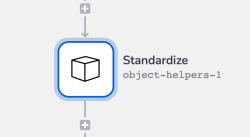 This Object Helpers step transforms the lead gen headers into a standard object with fields in the following format:
First Name --> first_name
Last Name --> last_name
Lead Source --> lead_source
etc.
For each lead we will then have a simple object which can be easily accessed by later Iterable steps using jsonpaths such as $.steps.object-helpers-1.result.first_name:
Email validation
The lead’s email address is validated for the appropriate user@domain.com format:
Create / Update Users
 A search is made for an existing user in Iterable using the lead’s email address as the unique identifier.
If a Iterable user does exist, the user record is updated.
If a Iterable user does not exist, a new user record is created.
A search is made for an existing user in Iterable using the lead’s email address as the unique identifier.
If a Iterable user does exist, the user record is updated.
If a Iterable user does not exist, a new user record is created.