










.DkNUKaKx_ZLAT4m.webp?dpl=dpl_8yJRSbiE1G6s3QrAKF7yU51bW2sQ)








Tray iPaaS / Merlin Agent Builder
Build AI agents that act, not just chat.
Merlin Agent Builder provides no-code agent development. Create production-ready agents from knowledge sources, tools, and reasoning — with guardrails, audit, and human-in-the-loop baked in from day one.
Thanks — someone from our team will be in touch soon.
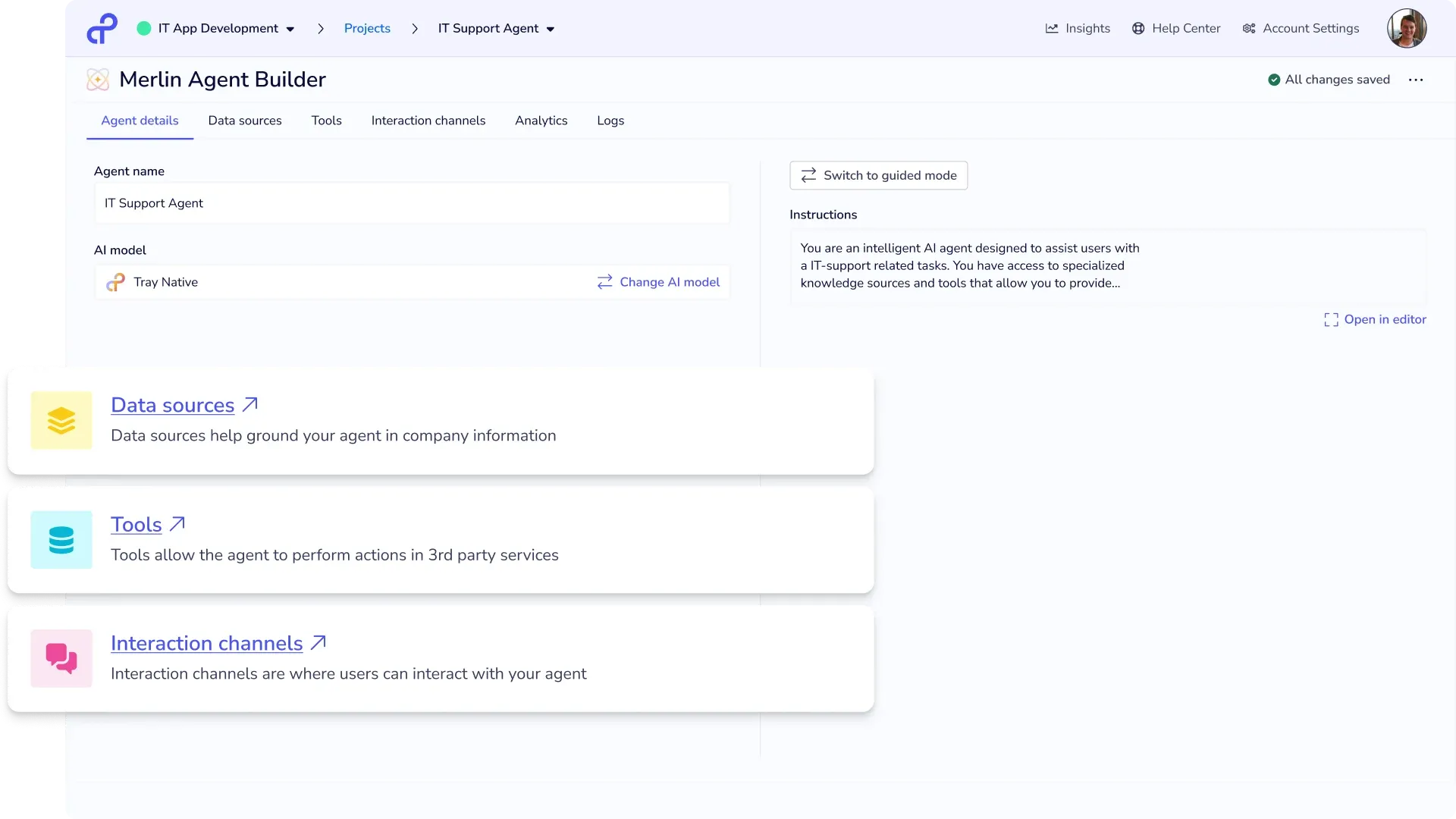
What it does.
Visual, no-code builder
A guided, visual experience for creating agents — knowledge, tools, reasoning, human-in-the-loop. Drop in code where you need it.
Multi-agent orchestration
Build agents that work together — a master agent coordinating sub-agents per department, each with their own tools and context.
Guardrails & audit
Every tool call logged. Per-user access control. Approval workflows for sensitive actions. PII protection.
Smart Data Sources
Ingest, partition, chunk, and embed automatically. Agents always get fresh, relevant context.
Multi-channel deployment
Ship the same agent to Slack, Teams, a chatbot, or an API. One build, many surfaces.
700+ app connections
Build tools that connect to any app in your stack for any action. Salesforce, Workday, Snowflake, Jira, and 700+ more.
Weeks not months, to build production agents
“The Agent Hub allows us to flexibly leverage Smart Data Sources and tools across sub-agents. This composable approach allows us to build agents in a matter of weeks, versus the months it would take by just building single-purpose agents.”
What you can build
See what teams build with Merlin Agent Builder.
Watch how purpose-built agents handle real work — short walkthroughs of how each one operates.
-
Watch
Campaign planning agent
This agent pulls industry news, spots campaign opportunities, and turns them into ready-to-run project plans. Built with Merlin Agent Builder.
-
Watch
CRM agent
Built with Tray Merlin Agent Builder, this CRM agent creates campaigns, adds contacts, flags at-risk accounts, and drafts tasks with follow-up emails.
-
Watch
Customer support agent
Built with Tray Merlin Agent Builder, this support agent resolves routine issues on its own and updates billing, CRM, and ticketing systems as it goes.
-
Watch
Data analysis agent
This agent pulls data from multiple tools, runs analysis, and creates dashboards. Made possible with Merlin Agent Builder.
-
Watch
Finance agent
This agent pulls data across systems, runs spend analysis, and creates shareable dashboards automatically. Built with Merlin Agent Builder.
-
Watch
HR service desk agent
Built with Tray Merlin Agent Builder, this HR agent checks entitlements, applies rules, and takes action so your team can stop fielding basic questions.
-
Watch
ITSM agent
This agent provisions apps, fixes access issues, and logs tickets with context. Built with Merlin Agent Builder.
-
Watch
Knowledge agent
Built with Tray Merlin Agent Builder, this knowledge agent finds gaps, updates articles, and turns analysis into Jira projects from your internal docs.
-
Watch
RFP agent
Built with Tray Merlin Agent Builder, this RFP agent finds accurate answers, escalates pricing questions, and processes full documents in Slack.
-
Watch
Sales pipeline agent
This agent spots pipeline risks, flags stalled deals, and takes action to move revenue forward. Built with Merlin Agent Builder.
Why is Merlin Agent Builder different?
Built different. By design.
No LLM lock-in
Every major LLM is pluggable. Swap models as the landscape evolves without rebuilding your agents.
Build any tool you want
Create custom tools for any action, API, or workflow — not just what a vendor pre-packaged for you.
Action-first, not chat-first
Agents that take real actions in your systems — not just answer questions. Unlock accounts, provision software, close tickets.
Teams already running on Merlin Agent Builder
Real results from teams running in production.

IT / Business Tech
Apollo's IT team was overwhelmed by tickets that scaled linearly with headcount. Existing AI vendors offered rigid, prebuilt agents — Apollo…
Read the story →
IT / Business Tech
Zuora runs 200+ SaaS applications across the enterprise. As AI capabilities surfaced across those systems — each with its own interface, ass…
Read the story →
IT / Business Tech
Life360 runs a consumer platform with 88 million monthly active users and a growing internal team. Early attempts at single-purpose bots lef…
Read the story →Frequently asked questions
What is an AI agent builder?
+
An AI agent builder is a platform for creating autonomous software agents — programs that use AI reasoning to plan, make decisions, and take actions in your systems without step-by-step instructions for every scenario. Unlike traditional automation, which follows fixed rules, agents reason about a goal and choose the right tools and sequence to achieve it. Merlin Agent Builder is Tray.ai's no-code platform for building, deploying, and governing these agents in enterprise environments.
How is an AI agent different from workflow automation?
+
Workflow automation follows a fixed sequence of steps — if A happens, do B, then C. AI agents reason about a goal and decide which steps to take, in what order, based on context. That means agents handle situations that weren't explicitly programmed. Merlin Agent Builder combines both: agents that reason, plus Tray.ai's 700+ connector library for reliable action on any system of record.
Is this no-code or low-code?
+
Both. The visual builder covers most patterns. Custom code steps are available anywhere you need them.
How does it compare to LangChain or CrewAI?
+
Those are open-source frameworks — powerful but unmanaged. Merlin Agent Builder gives you the same expressive power with enterprise governance, observability, and audit trails built in. You don't ship a LangChain stack to prod; you ship with Merlin Agent Builder.
How does it compare to n8n?
+
n8n is a workflow tool that's added AI steps — it's not built for agents. You get no guided agent builder, no multi-agent orchestration, no Smart Data Sources, and no enterprise governance. You're also self-hosting and maintaining it. Merlin Agent Builder is purpose-built for production agents: governed, composable, and no-code where you want it. See the full comparison at /compare/tray-vs-n8n.
What about context? Agents need real data.
+
Merlin Agent Builder connects to Tray.ai's 700+ connector library directly. Agents can query Salesforce, read docs in Notion, pull metrics from Snowflake — governed through the same RBAC as every other integration.
Tray iPaaS
Built as one. Not stitched together.
Every capability runs on the same connector library, governance layer, and data model — designed together from day one.
See Merlin Agent Builder in action.
Walk through a scenario from your stack with a Tray.ai expert.
Thanks — someone from our team will be in touch soon.