

Most teams describe lead handling as a list of jobs: upload the list, enrich it, match it, score it, route it. Each has an owner, each has a tool, and each gets fixed on its own when it breaks.
A lead does not experience it that way. A lead enters at one end and either comes out the other end assigned to a rep, or stops somewhere in the middle. Running those jobs as one pipeline rather than six changes what you can see when something goes wrong, which is the whole reason the distinction matters.
What is a lead processing pipeline?
A lead processing pipeline is a single sequence that takes a raw lead from capture to a routable record, applying validation, deduplication, enrichment and creation in a fixed order before anything downstream sees it.
The defining feature is that a record cannot skip a stage. A lead that fails validation does not proceed to enrichment holding bad data. A lead that cannot be enriched does not proceed to scoring with empty fields. Each stage either passes the record on or holds it, and holding is a legitimate outcome rather than a failure.
The stages, in order
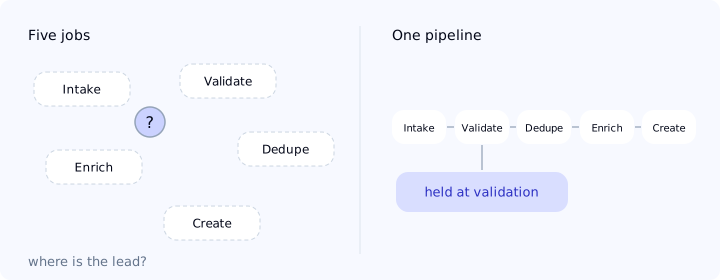
Intake. Leads arrive from forms, events, list uploads, partner files and API calls. Intake’s job is to accept all of them into one shape. Teams that let each source write directly into the CRM end up with as many formats as they have sources, and every downstream rule has to handle all of them.
Validation. Check the record before it enters, not after. Is the email syntactically valid and not a known disposable domain. Is the company field populated. Is this a test submission from someone on your own team. Cisco cut invalid leads by 60% by handling this upstream rather than letting sales find the problems.
Deduplication. The same person fills in two forms in a week and the same company arrives under three spellings. Catching that at intake is cheap. Catching it after routing means two reps have already called. Dedupe and merge covers the mechanics.
Enrichment. Fill the fields the lead arrived without, and decide what happens to the records your vendor cannot resolve. Where enrichment stalls.
Creation. Write the record into the system of record with the fields downstream needs, in the shape downstream expects.
Only then does the record reach matching, scoring and routing. The six steps and where each one breaks covers those in sequence.
Why the pipeline framing matters when something stalls
Six separate jobs give you six separate places to look and no way to tell which one a given lead died in. A pipeline gives you a position.
That difference shows up on a specific kind of bad day. Leads from one campaign are not reaching sales, and nobody can say why. With six jobs, someone checks the routing rules, finds them fine, checks enrichment, finds it fine, and eventually discovers that the form on one landing page posts a company field the validation step rejects. With a pipeline, the records are sitting in a held state at validation with a reason attached, and the question is answered in a minute.
The stall almost always happens at a stage boundary rather than inside a stage. Enrichment works; what breaks is what enrichment does with a record it could not resolve. Validation works; what breaks is what happens to a record it rejected. The stages are the easy part to build and the boundaries are where the decisions live.
Why this used to be a platform decision and now is not
Building a pipeline like this was once a project. It needed a tool that could hold state between stages, retry a failed vendor call, and hold a record without losing it.
That constraint is gone. Any of these stages is an afternoon with a coding assistant, and the first version handles the happy path correctly. The boundaries are what the first version does not handle, and they are also the part nobody notices is missing until a campaign lands.
Gartner describes the distance between a working prototype and something running in production as the defining constraint in this market
, and says to treat it as a planning constant, not a temporary limitation.
1 That is a useful thing to know before you build the fourth stage rather than after.
The work is also growing. Gartner expects 75% of RevOps tasks in workflow management, data stewardship, revenue analytics and revtech administration to be executed by agentic AI by 2028.2 More of this pipeline gets built, not less, which makes where it gets built the decision that matters.
Which of your automations breaks first? Take the assessment — it ranks what your team already runs by who can change it, how you would find out it stopped, how many systems it touches, and what a break costs.
Sources
- Gartner, Market Guide for Enterprise Vibe Coding Platforms, Swan, Bhat, Blosen, 28 April 2026, G00844703.
- Gartner, AI Agents Will Redefine How RevOps Drives Go-to-Market Success, Rietberg, O’Sullivan, Lopez, 9 July 2025, G00826255.
GARTNER is a registered trademark and service mark of Gartner, Inc. and/or its affiliates in the U.S. and internationally and is used herein with permission. All rights reserved.