

Gartner® publishes Hype Cycles for a lot of things. But until now, agentic AI didn’t have one.
That just changed. The 2026 Hype Cycle for Agentic AI™ is Gartner’s first attempt to map the entire agentic AI landscape — 30+ innovations, from MCP and multiagent systems to agent governance, agent management platforms, and everything in between.
It’s a landmark report. And it doesn’t pull its punches.
Here are five things that stood out.
Hard truth #1
The adoption wave is coming faster than most organizations are ready for
Gartner’s 2026 survey found that 17% of enterprises have deployed AI agents so far. Another 42% plan to do so in the next 12 months — and 22% more in the year that follows. Gartner calls it the most aggressive adoption curve of any emerging technology in their survey.
That’s one heck of a wave, yet most organizations are still learning how to swim.
The gap between where enterprises are today and where they’ll need to be in 24 months is the undercurrent of this entire report.
Hard truth #2
Deploying agents and orchestrating them are completely different problems
Most current agent deployments are single-purpose — built for one task, inside one system, with limited connection to the broader enterprise. Gartner is direct about what that gets you: incremental value, at best.
The harder problem — and the one most organizations haven’t started solving — is coordination. Getting agents to work together across systems, share context, hand off work reliably, and operate within defined boundaries. That’s orchestration. And it’s a fundamentally different infrastructure challenge than building an agent in the first place.
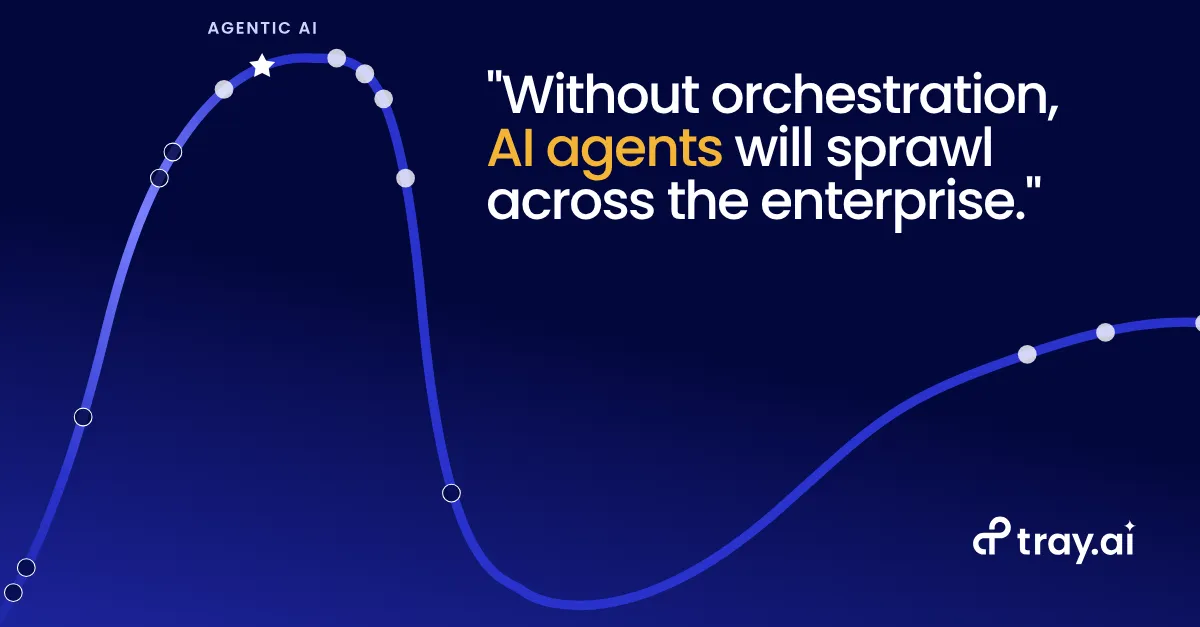
“Without orchestration, AI agents will sprawl across the enterprise and become chaotic and unmanageable, limiting business impact.”
Hard truth #3
Agent washing is already muddying the market
If you’ve noticed that every automation vendor suddenly has “AI agents” in their product messaging, Gartner noticed too.
Gartner first coined the term “agent washing” in 2025 — legacy automation tools and RPA solutions rebranded as AI agent platforms — and many are still washing away. The marketing is making it harder for buyers to distinguish between genuine agentic capability and traditional automation with a new coat of paint.
For IT and architecture leaders evaluating vendors right now, this is a practical warning. Demos are easy to stage. Ask harder questions about what’s actually happening beneath the surface.
Hard truth #4
Governance is needed today, not tomorrow
Governance, agent management, and agentic AI security run through the entire report — and the story is the same across all three: you can’t bolt governance on after the fact.
As agents gain access to more systems, make more decisions, and operate with greater autonomy, the blast radius of a poorly governed deployment grows. This extends to connectivity standards too. Gartner recommends adopting MCP now for connecting agents to enterprise systems, but pairs that recommendation with an explicit warning: implement an MCP gateway to keep access governed, observable, and auditable. Even the most promising standards create new security exposure when governance is an afterthought.
Organizations that treat governance as a checkbox will pay for it later.
Hard truth #5
The cost problem nobody is planning for
Most conversations about agentic AI focus on capability. Almost none focus on cost — and Gartner thinks that’s a problem.
Unlike traditional software with predictable per-user pricing, agentic AI costs are driven by decisions, not seats. Every LLM call, tool retry, reasoning trace, and multiagent loop adds to the bill. In complex deployments, those costs can spiral quickly with very little visibility into what’s driving them.
“Without rigorous financial guardrails, attribution and observability, these systems can spiral into unpredictable token spend and API charges with little insight into actual ROI.”
Most enterprises haven’t started thinking about this yet. The ones that wait until agents are in production to figure it out will wish they hadn’t.
There’s a lot more to learn
These five findings barely scratch the surface. The full report covers 30+ innovations across agent development, deployment, management, governance, and use cases — with Gartner’s maturity assessments and actionable guidance for enterprise AI leaders.
If you’re making decisions about AI infrastructure in 2026, this should be required reading.
Gartner® Report
Hype Cycle for Agentic AI 2026™
30+ innovations mapped. Maturity assessments across agent development, deployment, management, and governance — with Gartner's guidance on what enterprises should do about each one.
Access the report →Gartner® Disclaimer
GARTNER is a registered trademark and service mark of Gartner, Inc. and/or its affiliates in the U.S. and internationally. Hype Cycle is a registered trademark of Gartner, Inc. and/or its affiliates and is used herein with permission. All rights reserved.
Gartner does not endorse any company, vendor, product or service depicted in its publications, and does not advise technology users to select only those vendors with the highest ratings or other designation. Gartner publications consist of the opinions of Gartner’s business and technology insights organization and should not be construed as statements of fact. Gartner disclaims all warranties, expressed or implied, with respect to this research, including any warranties of merchantability or fitness for a particular purpose.
Gartner, Inc. Hype Cycle for Agentic AI, Rajesh Kandaswamy, Leinar Ramos, Gary Olliffe, Tom Coshow, Pieter den Hamer, Erick Brethenoux, 2 April 2026