

Usability is now a velocity decision
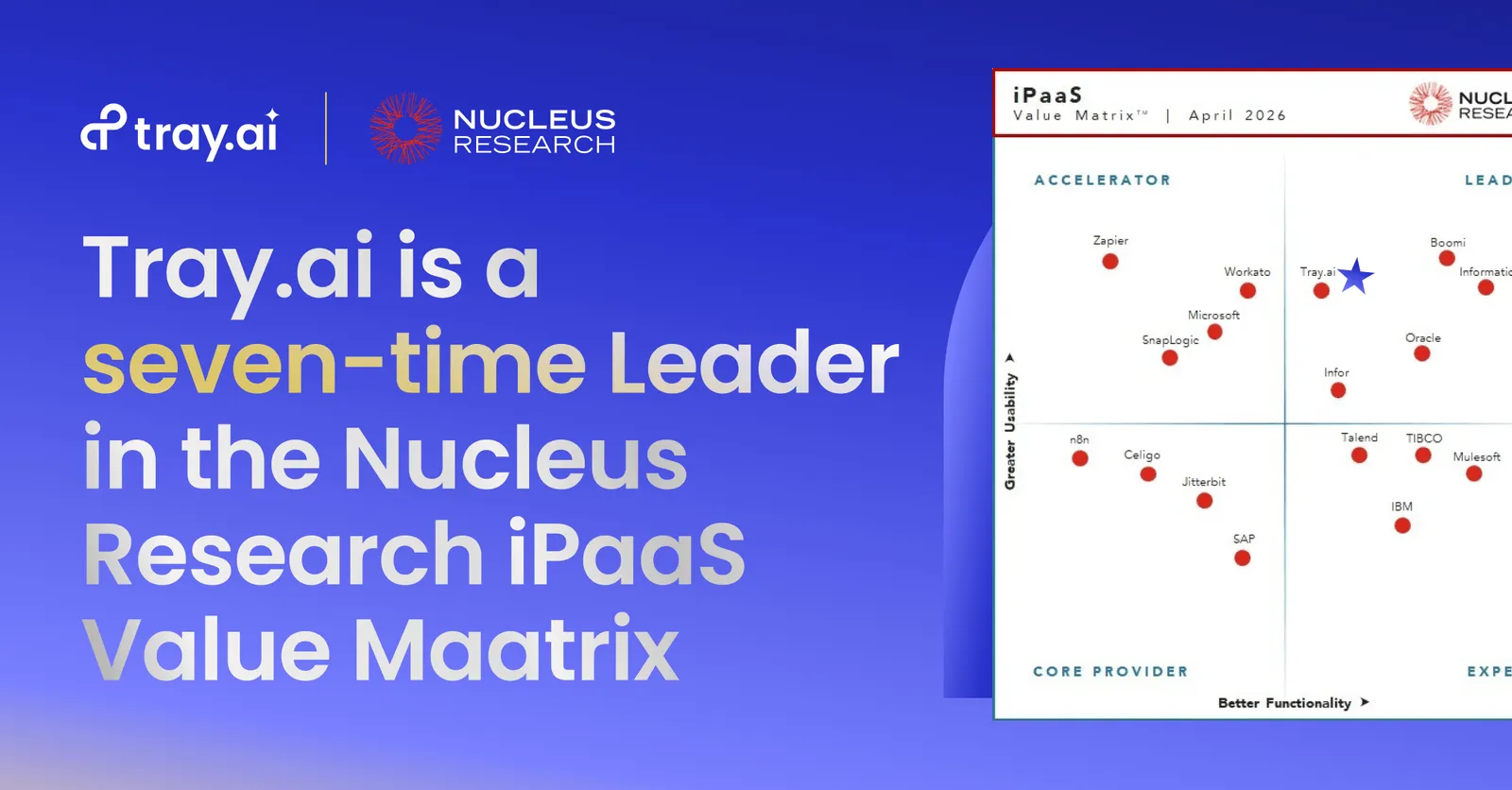
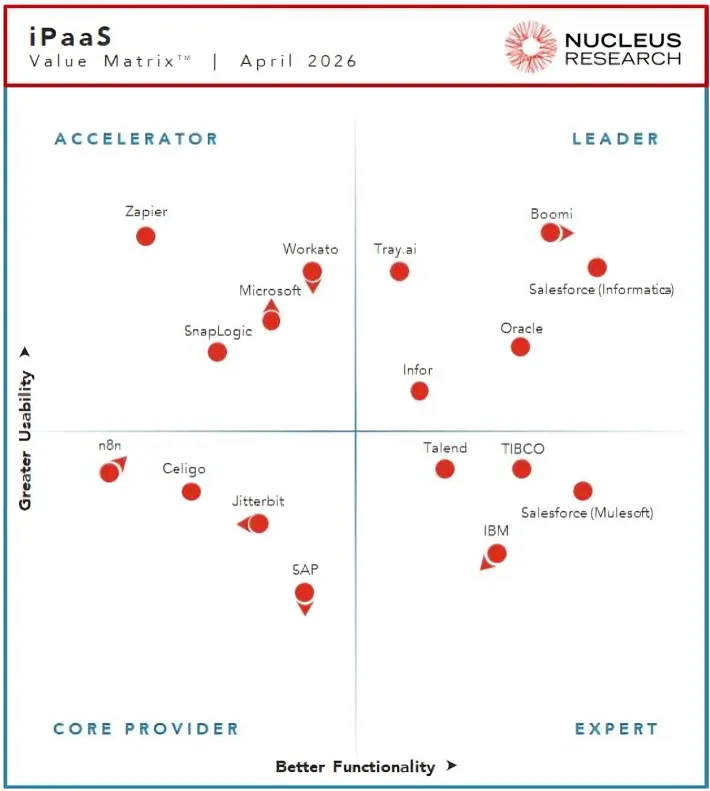
Your integration platform is either accelerating your AI program or taxing it. Nucleus Research scores iPaaS platforms on two axes: usability and functionality. Functionality gets most of the attention — connector counts, throughput, enterprise feature sets. But AI has quietly made usability the more consequential dimension.
The reason is pace. AI is moving faster than any implementation cycle was designed to handle. New models, new agent patterns, new integration requirements don’t arrive on a quarterly roadmap. They arrive continuously. A platform that takes weeks to configure or requires specialist knowledge to adapt is not a neutral constraint. It is a direct cost to how fast an organization can move.
This is what makes the usability axis worth watching. It’s not necessarily a measure of how easy something is to learn, but a proxy for organizational velocity.
See how Tray.ai compares: Tray.ai vs. Boomi · Tray.ai vs. Informatica
From automation to orchestration
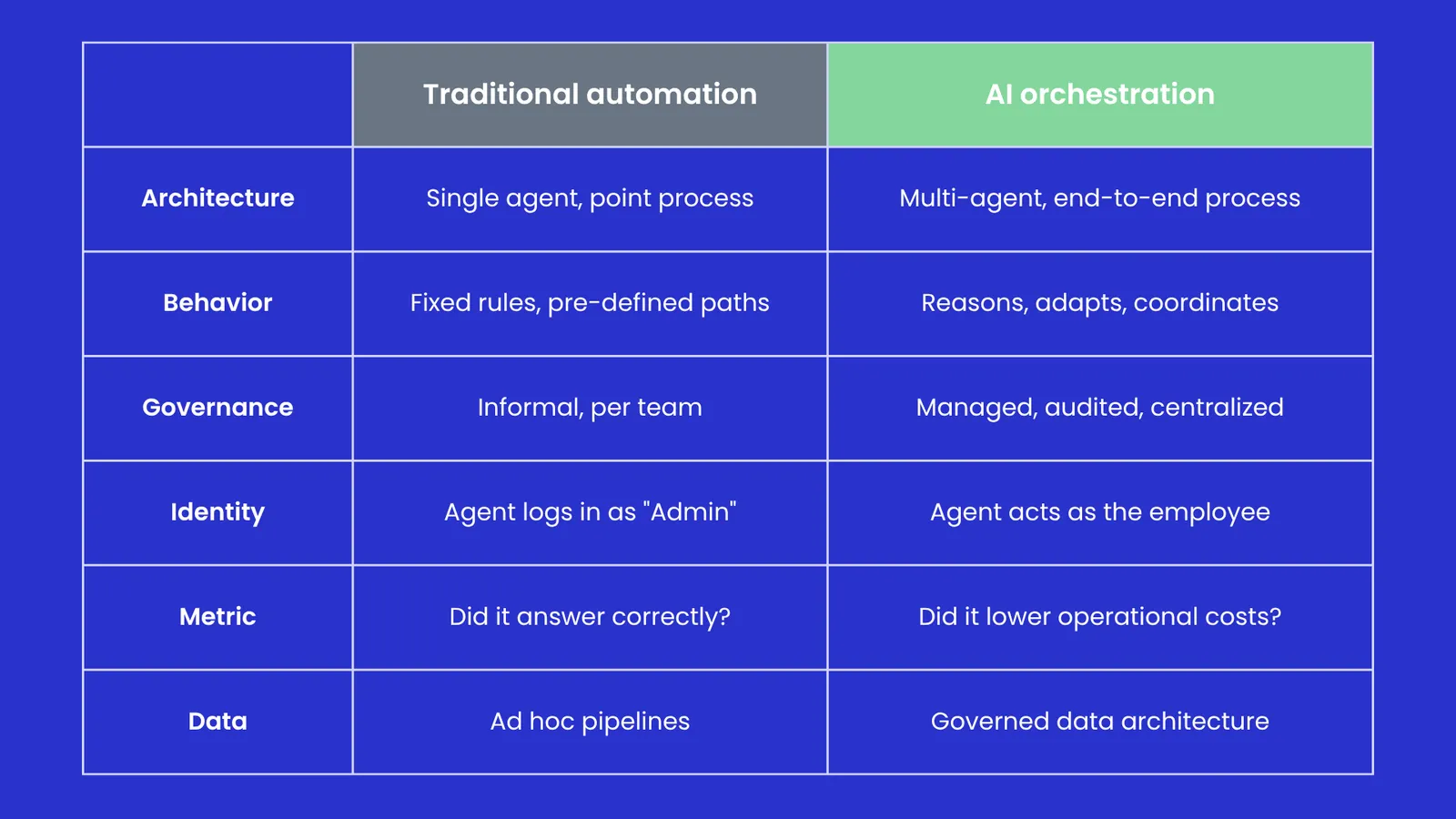
For most of the past decade, iPaaS was fundamentally about moving data and triggering workflows. Connect system A to system B. Automate the handoff. Reduce manual steps. Valuable, but reactive and rule-based.
AI orchestration is a different problem. It involves coordinating AI agents, models, data pipelines, and human-in-the-loop processes across an enterprise in real time. Most enterprise AI programs started with a single agent doing a single job. That was the right place to start. But production AI at scale involves multiple agents coordinating across systems, handing off context, sharing tools and data, making decisions that affect each other. The integration layer underneath needs to be fast, reliable, contextually aware, and governable in ways that older architectures weren’t designed for.
AI is only as useful as the data it can access and act on, and enterprises that underinvested in integration are discovering that gap now, at exactly the moment they need it closed.
MCP: the connectivity layer agents actually need
The Model Context Protocol has emerged as the standard for connecting AI agents to the tools and systems they need to operate. Where APIs required custom-built connectors for every integration, MCP provides a common interface. Agents can read data, take actions, and interact with enterprise systems without bespoke engineering for each connection.
Most of the iPaaS market hasn’t moved meaningfully on MCP yet. For enterprises building agentic workflows, that distinction has practical consequences: faster deployment, broader connectivity, and governance built into the connection layer from the start.
What that looks like in practice is instructive. Marcus Dubreuil, Director of Systems Architecture at J.W. Pepper, describes the shift his team made after centralizing MCP through Tray’s Agent Gateway for MCP: rather than exposing large numbers of raw tools directly to agents, they moved toward purpose-built workflows representing specific business actions. “Instead of us trying to build this whole robust all-in-one iPaaS solution, we’re just adding these little drops of determinism into what the agent can do.”
The result was a governed, repeatable model for MCP adoption that scaled without the sprawl that typically follows ungoverned agent deployment. Platforms without a credible MCP foundation face a compounding problem: the longer the delay, the more agent infrastructure consolidates around platforms that moved early.
—> Read the full J.W. Pepper story.
The window is open, but not for long
The organizations that get the integration foundation right first are the ones that will compound their advantage. The ones that don’t will find themselves optimizing on top of an architecture that was never designed for what they’re asking it to do.
The Nucleus Research matrix is a useful reference point. The more important questions it should prompt are practical ones: how fast can our teams actually build on our current platform? Are we MCP-ready? Does our integration layer reflect the pace we need to move at, or the pace we used to?
The iPaaS decision used to be about connectivity. Now it’s about velocity. Those are different criteria, and they point toward different platforms.