

If you’re an IT leader, Gartner® has a prediction that should be on a sticky note on your desk right now. By 2027, cybersecurity incidents tied to prompt injection, data access, or agent misconfiguration will impact over 40% of enterprise MCP deployments.
It could happen today. Many organizations are currently deploying MCP and making decisions about how tools are exposed, who controls access, what permissions agents inherit. Those decisions will determine whether an organization is in that 40% or not.
Here’s the scary part: Most of them are not making those decisions deliberately. They are barely making them at all.
How MCP adoption actually happens
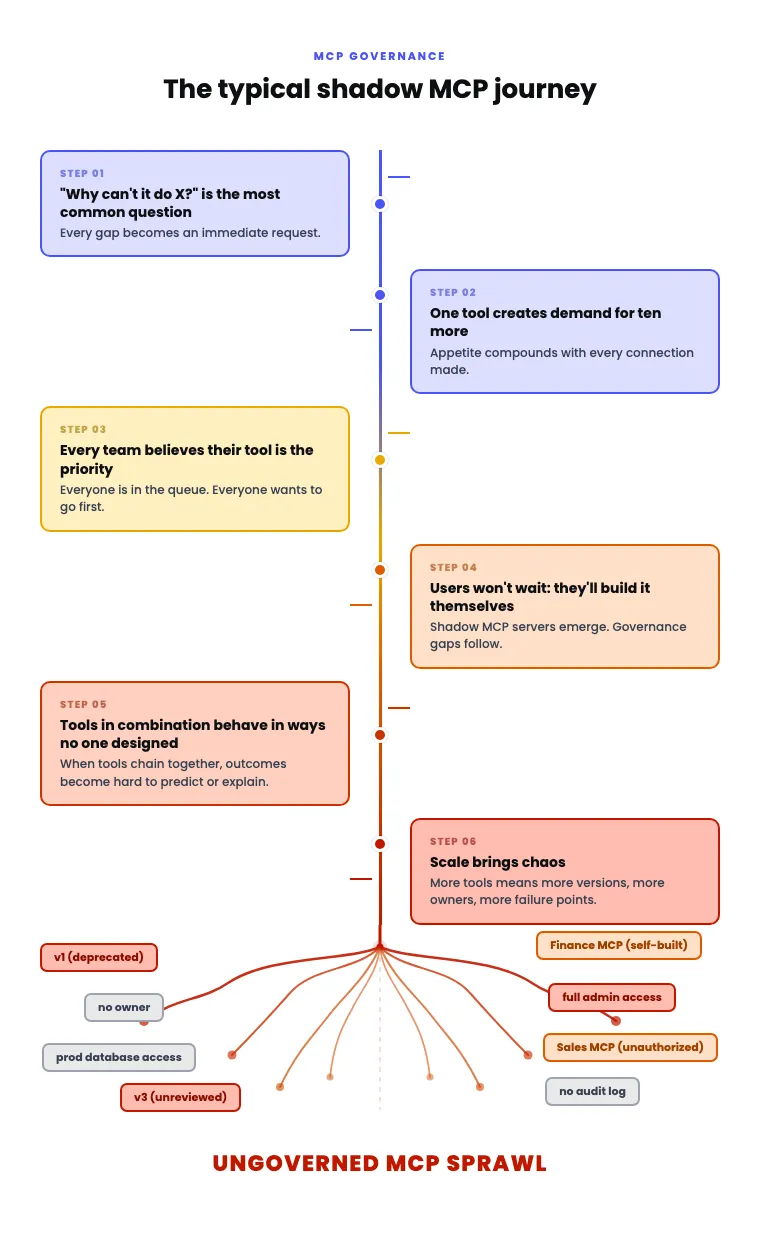
MCP adoption rarely begins with a governance conversation. It begins with someone on the engineering team noticing that their AI assistant can now take action in real systems, not just generate text. Then someone in finance builds their own MCP server to automate a reporting workflow. Then someone in sales connects their CRM. Then the requests start arriving in IT’s queue. But instead of requests for API integrations, they’re for MCP connections.
Marcus Dubreuil, Director of Systems Architecture at J.W. Pepper, saw this first-hand. “What used to be ‘this service has an API, can we integrate it?’ turned into ‘this service has MCP.’”
That change in language represents a change in risk profile. APIs were governed because IT controlled the integration layer. MCP tools, in many deployments today, are governed by no one. They run on local machines, connect directly to production systems, and inherit the full permissions of the user operating them. A researcher at Queen’s University studying 1,000 MCP servers found that 33% had critical vulnerabilities. Another study found a 92% exploit success rate when using just ten unmanaged MCP connections simultaneously.
The scale of exposure is building faster than most IT teams realize.
The three risks that compound each other
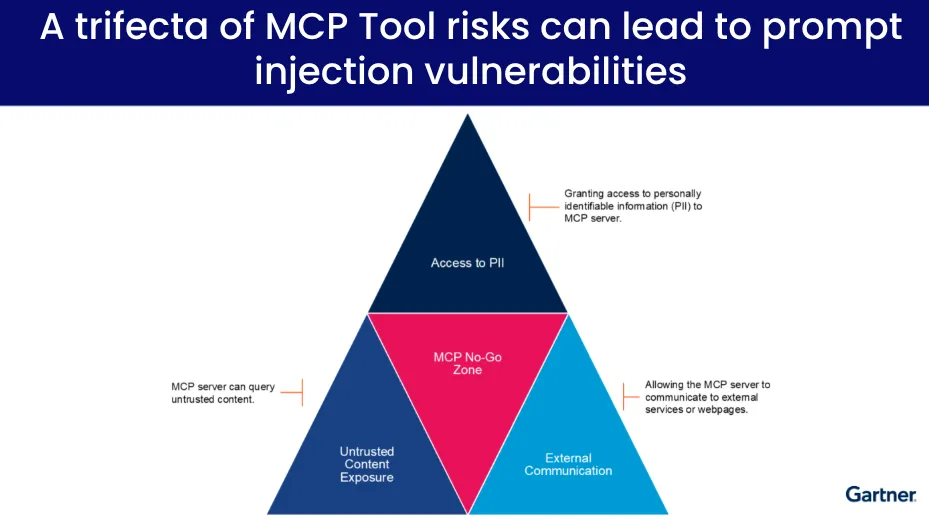
1. Prompt injection through untrusted content.
MCP servers that query external sources, web pages, documents, or user-generated content expose agents to inputs that can redirect their behavior. A well-crafted prompt embedded in a web page or email can instruct an agent to take actions the user never intended. If that agent has broad system access, the damage can be substantial before anyone notices something went wrong.
2. Overprivileged tool access.
Most MCP servers in use today are essentially API wrappers. They expose everything the underlying system allows and leave it to the agent — or the user — to restrict what actually gets used. In practice, that restriction rarely happens. The result is agents operating with far more access than they need for any given task. As Dubreuil put it: “One of the challenges with how MCP works that I learned really quickly is that it effectively forwards any access control that the user has to the AI agent. You’re effectively saying, ‘you’re me now.’”
3. External communication and data leakage.
MCP servers permitted to communicate with external services or pages create a path for sensitive data to leave the organization. This is not a theoretical risk. It is a structural property of how many MCP deployments are configured today.
Source: Gartner, “Best Practices to Counter MCP Security Risks,” 2026
When these three conditions overlap — and they frequently do — Gartner identifies the result as a prompt injection vulnerability. The threat is not a single failure mode. It is a set of conditions that compound each other silently until something goes wrong.
The shadow MCP problem
The security risks would be manageable if the MCP landscape were centrally visible. It is not.
Organizations that spent a decade eliminating shadow IT are now watching a near-identical pattern emerge with MCP. Teams outside IT build their own servers. Developers spin up MCP connections on local machines. Business users grant AI agents administrative access to systems because the alternative is waiting in a queue. Each new connection adds to an invisible inventory of tool access that IT has no way to audit.
The demand dynamics make this worse. Connecting one system to an AI agent immediately generates demand for ten more. Every business unit believes their use case is the priority. Users who can not get what they need through official channels will find another way. And when chained tools start behaving in ways that no individual tool was designed to produce, tracing the cause becomes extremely difficult.
The result is a fragmented MCP landscape — multiple owners, multiple versions, multiple permission surfaces — with no shared visibility into what is running, what it has access to, or what it is doing.
Why “add controls later” does not work
The intuitive response to this situation is to pilot MCP now and layer in governance once the use cases are proven. From a business perspective, that makes sense. Governance can slow things down. Slowing down is never seen as a good business practice.
The problem is that MCP governance is not additive. Once agents are running across the business with broad tool access and no central oversight, the act of introducing controls disrupts the workflows that have already been built around the absence of controls. Users who got used to unconstrained access push back. IT inherits a remediation project instead of an architecture decision.
Then costs begin to compound. Ten unmanaged MCP servers with an average of 15 tools each, at roughly 500 tokens per tool definition, consumes 75,000 tokens from the context window before a single query is answered. That is token spend going directly to overhead rather than to the work the agent is supposed to do. At scale, across multiple teams and agents, the cost impact will start putting on the brakes for you.
The organizations that avoided the shadow IT remediation cycle did not do it by adding governance after the fact. They did it by making governed tooling available before the ungoverned version became entrenched.
The architectural response
The correct response to MCP risk is not to restrict adoption. It is to make the governed path faster than the ungoverned one.
That means IT taking ownership of MCP as an infrastructure layer, in the same way it took ownership of API management and integration. It means providing a centralized environment where tools are registered, approved, versioned, and monitored — so teams can access what they need through a managed path instead of building their own.
Concretely, this looks like:
- A central registry of approved MCP servers and tools
- RBAC controls that determine what each user or agent can access
- Audit logs that capture who called what tool and when
- Rate limiting that prevents runaway token spend
J.W. Pepper took this approach. When Dubreuil implemented centralized MCP governance using Tray Agent Gateway for MCP, things began to accelerate. IT became the team that made MCP adoption possible rather than the team that had to clean it up afterward. “We’ve removed a lot of risk,” Dubreuil said. “There’s governance around that now.”
The other dimension of the architectural fix is tool design itself. Raw MCP tools give agents access to broad system capabilities and rely on inference to determine what to do with them. That is where hallucinations, inappropriate actions, and unpredictable behavior come from. Purpose-built tools that encode specific business logic — look up this order, update this ticket, check this status — remove the ambiguity. The agent gets a narrower set of actions it can call, each of which behaves the same way every time. That is how you get reliability, not just access.
What to do now
Three things matter most in the near term.
First, inventory your MCP exposure. That means knowing which MCP servers are running in your environment, who built them, what systems they connect to, and what permissions they operate with. For most organizations, this audit will surface connections that IT did not authorize and did not know existed.
Second, assume prompt injection attacks are coming. Do this as an operational posture. Any MCP server that queries external or user-generated content is a potential injection surface. Controls need to be in place before the first attempt, not after.
Third, enforce a policy approval path for new MCP connections before the backlog makes that impossible. The window to get ahead of shadow MCP is narrow. Once the pattern is entrenched, the remediation cost is significantly higher than the governance cost would have been.
The timer on that Gartner prediction is running. The organizations that manage MCP as infrastructure — with the same rigor applied to any other system access layer — are the ones that will not end up in that 40%.
Read Gartner’s report: Best practices to counter MCP security risks.
MCP is quickly becoming the integration layer for AI agents, but most organizations are still figuring out how to secure it. This Gartner® report outlines the security risks MCP introduces and the practices software engineering leaders should apply before deploying agents in production.
Gartner, “Best Practices to Counter MCP Security Risks,” Aaron Lord, Keith Guttridge, Alex Coqueiro, February 2026.
Gartner, “Manage the Cybersecurity Risks of the Model Context Protocol,” 2025.
GARTNER is a registered trademark and service mark of Gartner, Inc. and/or its affiliates in the U.S. and internationally and is used herein with permission. All rights reserved.
Gartner does not endorse any vendor, product or service depicted in its research publications and does not advise technology users to select only those vendors with the highest ratings or other designation. Gartner research publications consist of the opinions of Gartner’s Research & Advisory organization and should not be construed as statements of fact. Gartner disclaims all warranties, expressed or implied, with respect to this research, including any warranties of merchantability or fitness for a particular purpose.