
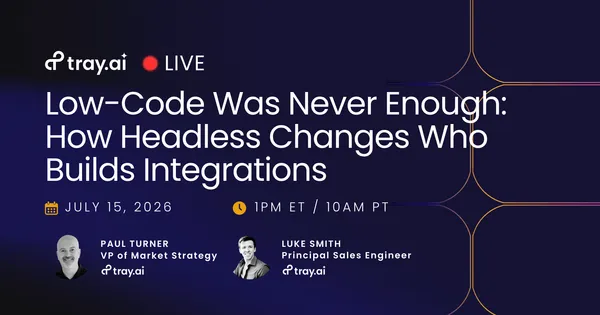
Low-code promised anyone could build. It delivered something narrower: a canvas that worked for a specific kind of work, done by a specific kind of person. Too hard for business teams, too rigid for developers. So integration stayed a bottleneck and the promise of democratization quietly stalled.
Claude Code and Codex with a headless iPaaS are changing who can build. In this session, Paul Turner walked through how — and what it means for integration teams navigating the shift.
What you’ll learn
- The broken promise of democratization and what headless changes. Why low-code didn’t deliver on its premise, and how headless integration reopens the question of who builds.
- What to look for in a headless integration platform. The capabilities that separate a genuinely headless platform from one that bolted MCP onto the side.
- The top use cases for headless integration. From migrations to net-new builds, the patterns showing up first and why.
- A live build from prompt to production. Luke took a real integration end-to-end, governed from the start.
This session is for you if:
- You were sold on low-code but integration is still a bottleneck and you want to understand why
- Your developers are working in Claude Code, Cursor, or Codex and your integration platform isn’t there
- You’re being asked to support AI development and aren’t sure what that means for your iPaaS
- You’re evaluating headless integration platforms and want to know what to actually look for
- You’re an IT or integration leader who needs the governance story to hold before you open up who can build
- You’re already on Tray and want to see how Tray Headless fits alongside Tray Build
What we covered
45 minutes:
- The broken promise of low-code and what headless changes (10 minutes)
- Live build from prompt to production, governed from the start (25 minutes)
- Live Q&A (10 minutes)
Common questions
Is this a sales pitch? The first 10 minutes are framing, the next 25 are a live build. We showed Tray Headless because it’s the platform we built for this. The vendor checklist and the architecture framing are useful whether you ever buy from us or not.
Can I share this with my team? Please do. Forward the on-demand link to anyone who’d find it useful.
We’re already running on Tray. Does this change anything for us? Tray Headless sits alongside Tray Build on the same platform. Nothing breaks. The session is worth your time if you have developers who’d rather build from their IDE, or if you’re sizing up a self-service motion across the org.
What if my team uses Cursor or Codex, not Claude Code? Tray Headless runs the full platform as MCP services in any MCP-compatible IDE. Platform-neutral, no lock-in.

Paul Turner
VP of Market Strategy

Luke Smith
Principal Sales Engineer, Tray.ai