










.DkNUKaKx_ZLAT4m.webp?dpl=dpl_8yJRSbiE1G6s3QrAKF7yU51bW2sQ)









A lead score is a claim about what deserves attention first. Every score is built on an assumption about which signals predicted revenue, and those assumptions were true when someone wrote them down.
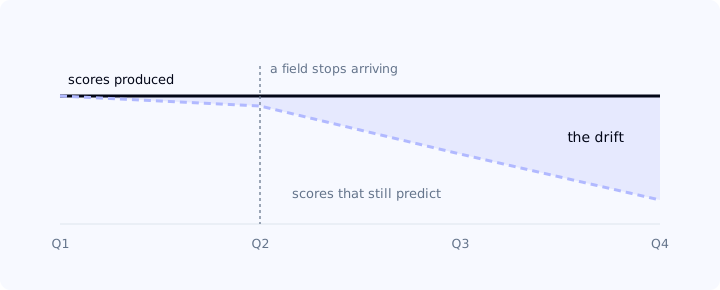
Scores fail differently from the rest of the lifecycle. An upload that breaks produces an error. A routing rule that breaks sends a lead to the wrong person. A score that has stopped being accurate keeps producing numbers that look exactly like the numbers it produced when it worked.
What is lead scoring?
Lead scoring assigns each lead a number representing how likely it is to convert, based on who they are and what they have done, so that limited sales attention goes to the leads most likely to be worth it.
Two kinds of signal go in. Firmographic signals describe the company and the person — industry, employee count, job title, region. Behavioral signals describe what they did — pages viewed, content downloaded, emails opened, demo requested, pricing page visited twice in a week.
How a score is built
Capture the signals. Behavioral data sits in the marketing automation platform, product usage sits in the product, intent data sits with a third-party vendor, and firmographics come from enrichment. None of it is in one place by default.
Decide which signals indicate intent. A pricing page visit means more than a blog visit. A director at a target-size company means more than a student. This is the judgment part, and it is usually based on what converted historically.
Generate the score. Apply weights, produce a number or a grade.
Write it back. The score has to reach the CRM, because that is where routing and prioritization happen. A score that only exists in the marketing platform cannot affect who calls whom.
Why scores drift
The market moved. The model was fitted to the deals you were winning eighteen months ago. Your ICP shifted, a competitor changed the market, or you moved upmarket. The weights still reflect the old shape.
A signal stopped arriving. Employee count comes from an enrichment vendor. The vendor changed a field name, or coverage dropped for a segment, and now that input is blank for a third of leads. The score still computes — it just computes without one of its main inputs, and blank usually reads as zero.
Someone added a rule and nobody removed one. Scoring models accumulate. A campaign gets a temporary boost that never gets switched off. Two rules now contradict each other and whichever runs last wins.
The scale inflated. Rules were added over three years and nothing was rebalanced, so now most leads score as high and the score no longer sorts anything.
The common factor is that none of these produces an alert. The score keeps arriving, reps keep working the top of the list, and the list has quietly stopped being ordered by likelihood of conversion.
What the score is for
Prioritization only matters because attention is finite and timing is real. A study of 5.7 million inbound leads across more than 400 companies, published in 2021, found conversion was substantially higher when the first contact attempt came inside five minutes.1 No rigorous public measurement has replaced it, so treat it as a shape rather than a current figure — but the shape is why sorting the queue correctly is worth doing at all. Getting to the right lead late is close to not getting to it.
Why this is becoming RevOps’ problem specifically
Scoring has historically lived with marketing operations, inside the marketing automation platform, using whatever scoring features that platform shipped.
That is changing because the inputs are moving. Product usage, third-party intent, warehouse data and enrichment all now feed scoring, and none of them arrives in the marketing platform without something being built. Gartner expects 75% of RevOps tasks in workflow management, data stewardship, revenue analytics and revtech administration to be executed by agentic AI by 2028 — and revenue analytics is where scoring sits.2
So the model stops being a configuration screen and becomes something your team builds and maintains. Which makes the question of what happens when an input goes missing a question your team now owns.
Where routing fits
Scoring and routing get discussed together because they run back to back, and they answer different questions. Scoring decides what a lead is worth. Routing decides who gets it.
The pairing matters because a score only changes an outcome if something acts on it. A model that correctly identifies the twenty leads most likely to convert this week has done nothing if all twenty land in the same unwatched queue. The reverse is also true: routing that sends leads to exactly the right rep in under three minutes is sending them in whatever order they happened to arrive.
Most teams fix one and assume the other is fine. Why routing rules outlive the org chart covers the second half, including what stale rules cost and why routing problems usually start upstream.
What scoring depends on
A score is only as good as the fields under it.
Firmographic weights depend on enrichment having populated them. Account-level scoring depends on matching having resolved the lead to the right account. The score’s effect depends on routing acting on it. And any of it being measurable depends on CRM data hygiene.
The full lifecycle chain covers how these steps depend on one another.
Which of your automations breaks first? Take the assessment — it ranks what your team already runs by who can change it, how you would find out it stopped, how many systems it touches, and what a break costs.
Sources
- XANT, Lead Response Report, 17 February 2021. Based on 55 million interactions and 5.7 million inbound leads across more than 400 companies.
- Gartner, AI Agents Will Redefine How RevOps Drives Go-to-Market Success, Rietberg, O’Sullivan, Lopez, 9 July 2025, G00826255.
GARTNER is a registered trademark and service mark of Gartner, Inc. and/or its affiliates in the U.S. and internationally and is used herein with permission. All rights reserved.