
The governed runtime for AI-built apps and agents
Your teams build apps and agents with AI. Helix runs and governs them.
IT stays in control of visibility, security, and everything that ships.

Thanks, keep an eye on your inbox for an invite.
Enforced by the runtime
Every app and agent deployed. Nothing ships ungoverned.
What is Helix
What is Tray Helix?
Tray Helix deploys, runs and governs the apps and agents your teams build with AI assistants such as Claude Code, Codex and Cursor. It is part of the Tray AI Orchestration Platform. One command puts an app on a live URL with a database, a named owner and connections to your systems through logins Tray holds.
The challenge
Your teams already build apps with AI.
Analysts, marketers, ops, and finance are building real apps in Claude Code and Cursor today. The apps work. What is missing is everything between a working prototype and software your org can actually run.
AI builds ever reach production and deliver real value
Tray analysis, MIT NANDA + S&P Global
found AI agents running in their environment they did not know about. 68% had believed their visibility was strong
Cloud Security Alliance, 2026
of organizations breached in their AI apps had no AI access controls
IBM Cost of a Data Breach, 2025
Thousands of vibe-coded apps have exposed corporate credentials and personal data on the open web, often with no authentication at all.
The gap
Teams build faster than IT can run and govern.
Many can build. Few can run. Even fewer can govern.
Why now
Ungoverned AI is now a board question.
The apps are already running. What changes from here is who gets asked about them, and what it costs when nobody can answer.
more per breach when shadow AI is involved, $4.63M against $3.96M
IBM Cost of a Data Breach, 2025
or 7% of global turnover, the maximum EU AI Act penalty for prohibited practices
EU AI Act, Art. 5 and Art. 99
The path
People build wherever they want. Everything ships through one path you control.
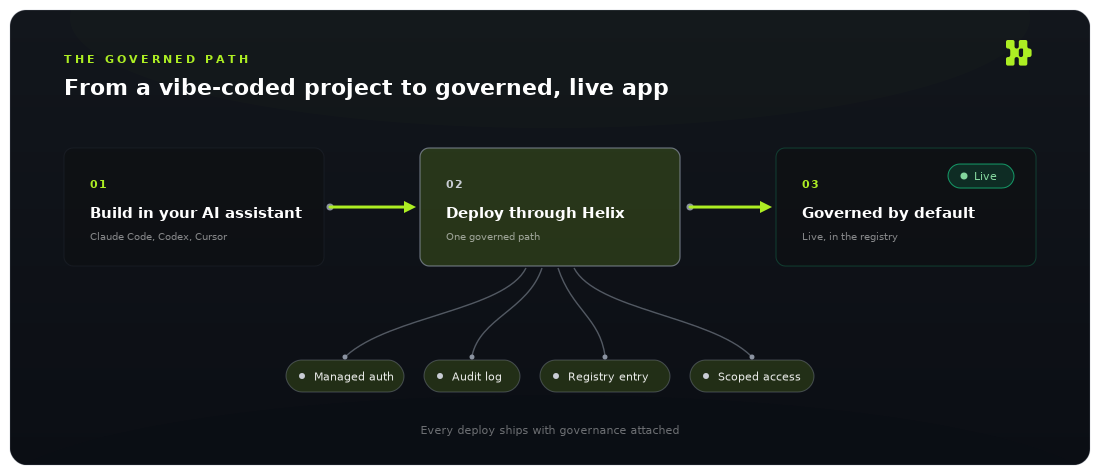
Developers and business teams now build real apps in their AI tool of choice, right up until production, where a working prototype needs weeks of infrastructure no builder owns. Helix takes those apps to production and runs them on a managed runtime: one command ships the app, Tray runs it, and governance is applied as it goes live. Every app lands in a registry, so nothing runs in the dark.
- 01
Build in your AI assistant
Your teams build where they already work. No new IDE, no visual builder, no tool to adopt.
- 02
Deploy through Helix
One command ships the app and its agents, with a database and files of their own. Identity, managed auth and a registry entry attach on the way, and an API token lets other systems call it.
- 03
Governed from the first request
IT gets visibility, security, and a named owner on everything that runs. Every app is listed with an owner before anyone opens it.
The platform
What every app and agent gets, from the first deploy.
Helix is the governed runtime for AI-built apps and agents. Each part below applies to every app and agent your teams ship, so your security posture comes from Helix, not from whoever built the app. Each has its own page.
Tray Helix
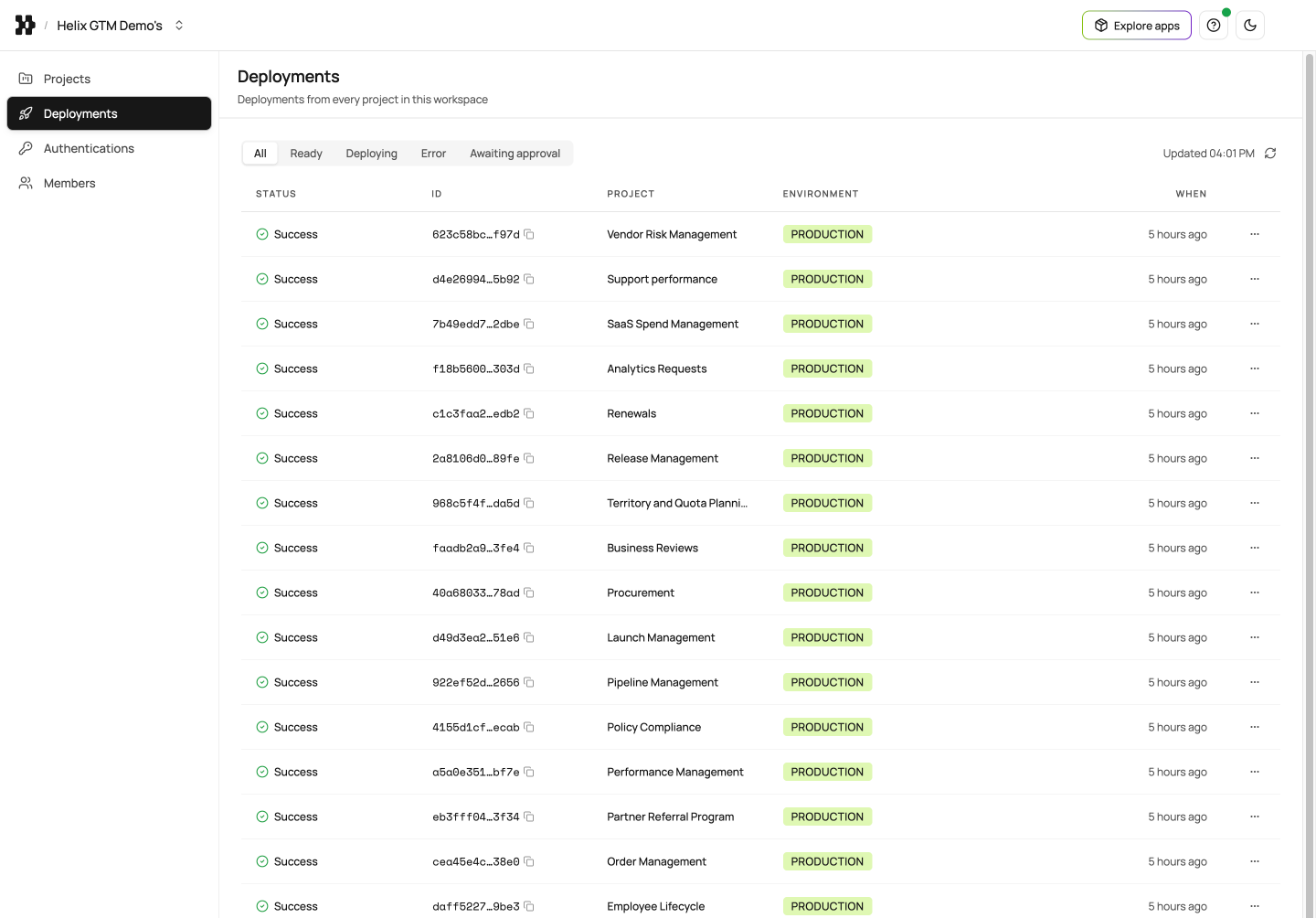
Deployment: approved, recorded, reversible
Deploy from your AI assistant or from CI. Hold deployments for approval, and restore an earlier version when you need to.
- One command or every merge
- Approval before a new app goes live
- Restore a previous deployment
Tray Helix
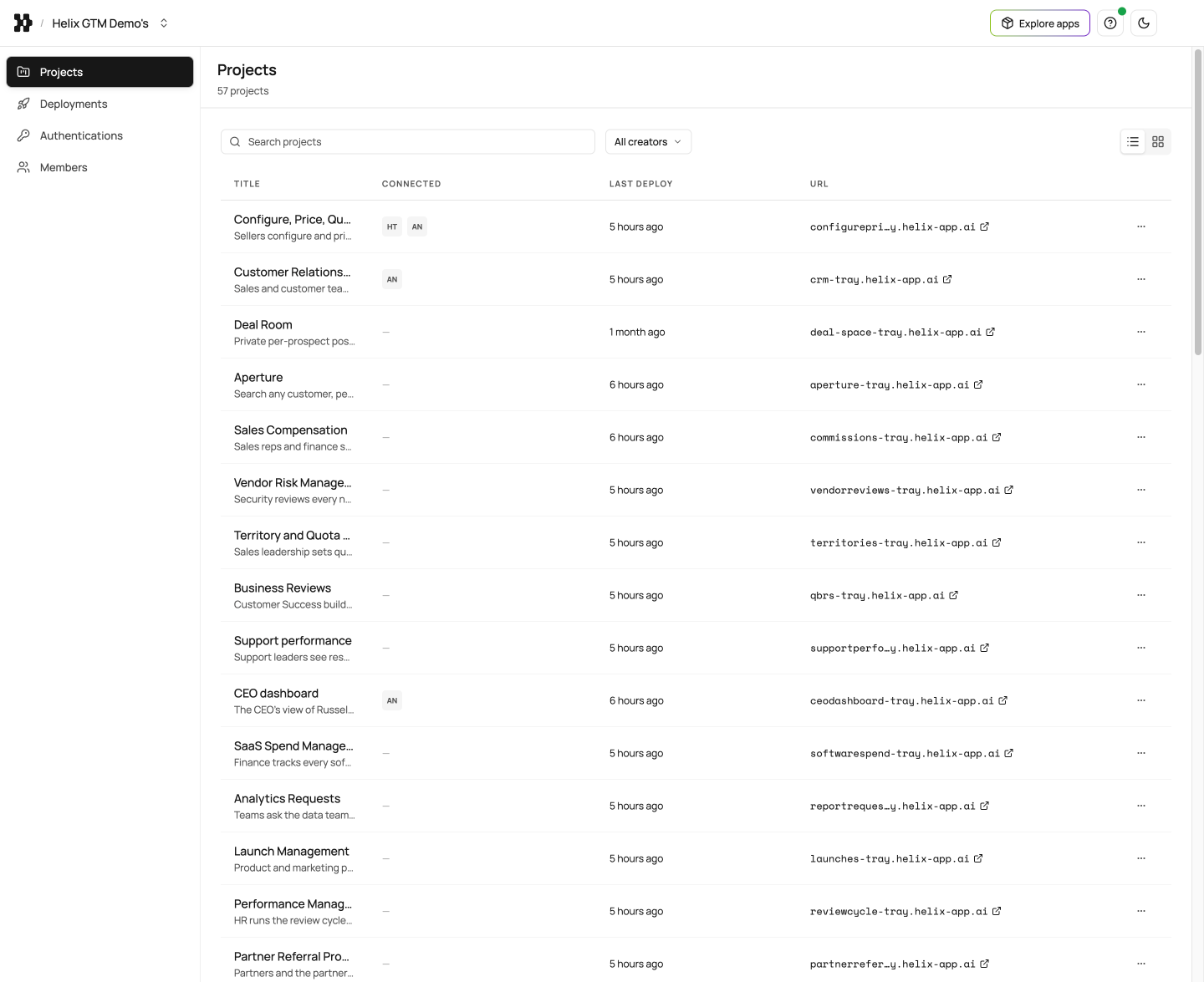
Apps: one command to a live, governed URL
Describe an app to your AI assistant and deploy it. It runs on Tray with sign-in, a database and a named owner from the first request.
- Live URL behind login
- A built-in database its agents use too
- Listed in the App Registry with an owner
Tray Helix
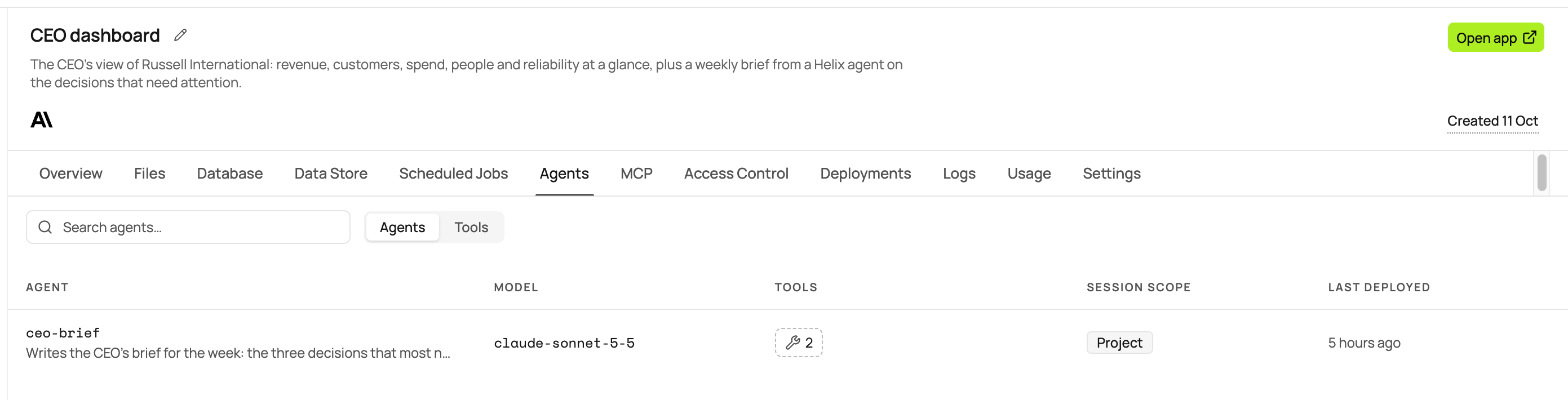
Agents: inside the apps they serve
An agent lives in its app, uses the model and tools you give it, and ships with the app on the next deploy.
- Model and tools set per agent
- Writes wait for a person to approve
- Runs on a schedule or on request
Tray Helix
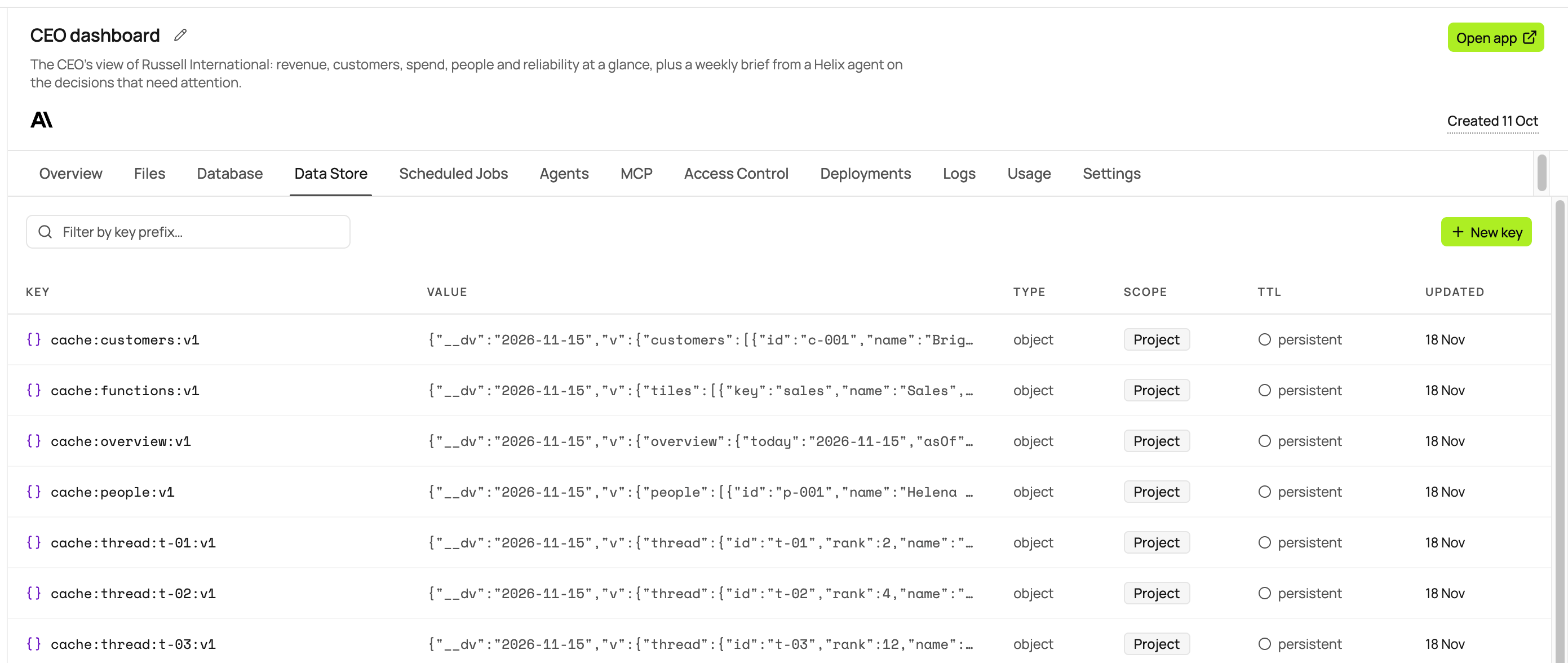
Data: a database, files and schedules in every app
Every app gets its own database, key-value storage, file system and scheduled jobs when it deploys. Its agents work on the same data.
- App database with nothing to provision
- Files and key-value storage built in
- Scheduled jobs on the app’s own data
Tray Helix
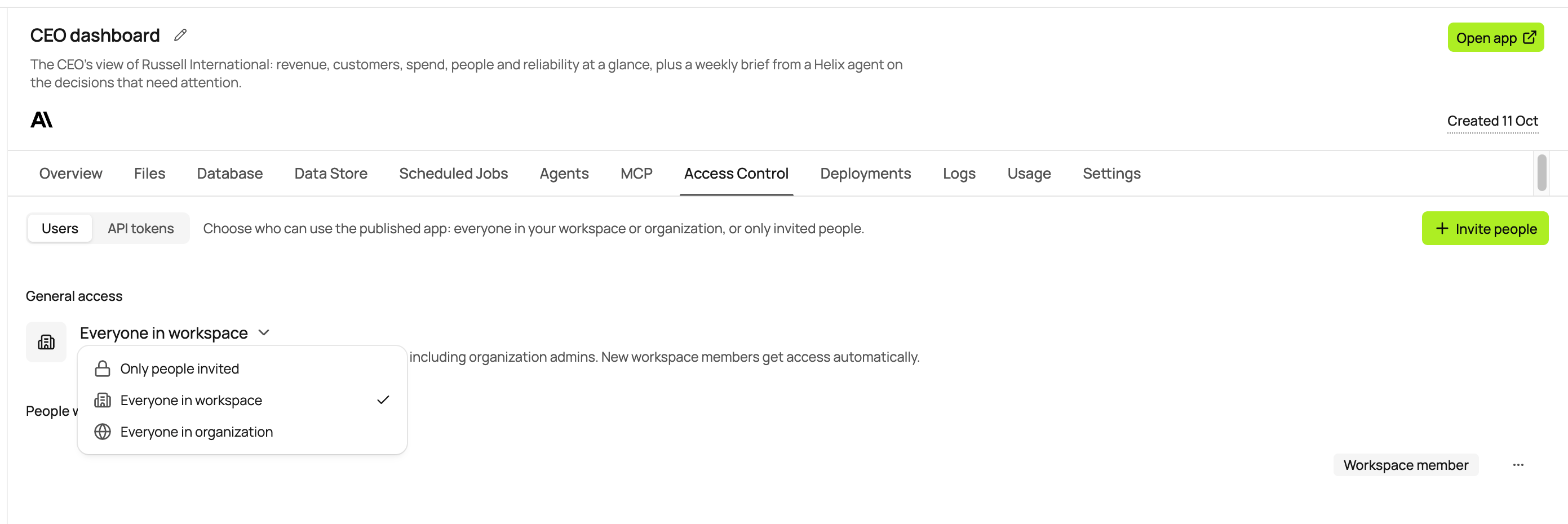
Security: sign-in and roles on every app
No app goes live without company sign-in. Choose who can open each app, and keep every login out of the code.
- SSO on every app, no public mode
- Logins held by Tray, never in code
- API tokens that act as a named user and expire
Tray Helix
AI Gateway: every model call through Tray
Apps and agents call AI models through Tray, which holds the provider key and tracks usage for each app.
- No provider key in code
- Usage tracked per app
- Choose the model, with fallbacks
Who it's for
What each team gets from Helix
The team that builds the app, the team that owns the path to production, and the team that has to answer for it. All three get what they need from Helix.
For business teams
The app your team keeps asking IT for, built by the people who actually need it. Campaign Studio, Quote Builder, Budget Planner and more, live in production and wired to the systems you already run.
- Marketing
- Sales
- Finance
- HR
- Customer success
- Customer support
For IT
Stop being the bottleneck without giving up control. One governed path every AI-built app and agent takes to production, with an owner, scoped access, and an audit trail on each, and you decide what ships.
- Deployment
- Visibility
- Access
- Registry
- Cost
- Scale
For security
Every app deployed through Helix, visible and owned from its first request. No raw credentials in code, security reviews that take days instead of weeks, and a registry with a named owner on every app.
- Control shadow AI
- Manage credentials
- Shorten reviews
- Cut audit risk
- Prove compliance
- Reduce exposure
Results
What teams get back with Helix.
What teams got back once they could build, deploy, and govern their apps in one place.
contact-center advisors on apps the team built themselves, instead of a six-month project
Membership and insurance company
to a working media plan builder, not 18 months
Digital media company, about 2,000 people
apps live in one week, built by a team of three
Fintech company
to vibe code a whole three-region portal
Marketing technology company
The foundation
Helix runs on the Tray platform, which already handles 1T+ processes a year.
Tray Helix and Tray iPaaS are complementary. Run Helix alongside Tray iPaaS, or go all in on Helix.
Helix runs on the Tray platform, which already handles 1T+ processes a year, with a track record of 100% workflow execution uptime over the trailing 90 days. Your AI-built apps run on that platform from day one.
- 1T+
- processes / year
- 100%
- workflow execution uptime, trailing 90 days
IT approves apps and keeps control
Say yes to what teams build with AI, with every app governed the same way.
Apps reach production
What your teams build with AI runs for the whole team, not on one laptop.
Every app visible and owned
Each AI app has a named owner and sits under the same governance from day one.
Logins held by Tray, never in code
Managed auth, nothing hardcoded, and a security review with nothing to chase.
Get started
Deploy your first app from the terminal.
Install the Helix CLI, sign in and start a project. Build it with Claude Code, Codex or Cursor, then ship it with one command.
 Helix CLI
The questions IT asks first
What is Tray Helix?
Tray Helix deploys, runs and governs the apps and agents your teams build with AI assistants such as Claude Code, Codex and Cursor. One command puts an app on a live URL with a database, company sign-in and a named owner, connected to your systems through logins Tray holds.
What is a vibe coding platform?
A vibe coding platform lets you describe an app in plain language and get working software. Tray Helix is where vibe-coded apps run: your AI assistant, such as Claude Code, Codex or Cursor, writes the app, and Helix deploys it with one command, with a named owner and your systems connected.
Do I need Tray iPaaS to use Tray Helix?
No. Every plan includes both. Start with Helix and add iPaaS integrations when you need them.
Is Tray Helix free?
Yes. Tray Helix is included in Tray Free, with a one-time $100 starter credit and no per-user fees.
How do you deploy an app built with Claude Code or Cursor to production?
With Tray Helix, a builder deploys the app with one command to Tray’s managed runtime. There is no infrastructure to stand up. The app gets a live URL, a managed database, a named owner and connections to your systems through logins Tray holds.
Can Tray Helix run AI agents?
Yes. A team defines an agent in its app’s code, and the agent deploys with the app and acts through the app’s tools. Any tool can wait for a person’s approval before it runs, and agent runs appear in the logs.
How do enterprises govern vibe-coded and AI-built apps?
Every app deployed through Tray Helix lands in the App Registry with a named owner, so IT can see what is running and who owns it. Credentials are held by Tray, so builders and AI assistants never see a raw credential. AI and compute spend is visible per app. IT can also hold deployments for approval.
Where can I host apps built by AI coding agents, with a managed database and login?
Tray Helix hosts them. One command deploys an app built with Claude Code, Codex or Cursor to Tray’s managed runtime. The app gets a live URL, a managed database, a named owner and connections to your systems through logins Tray holds, and it sits behind login. IT sees every app in the App Registry.
How do you turn an AI prototype into a production internal app?
With Tray Helix, one command takes a prototype built in Claude Code, Codex or Cursor to Tray’s managed runtime. The app gets a live URL, a managed database and company sign-in, lands in the App Registry with a named owner, and IT can hold the deployment for approval.
Which vibe coding platform gives enterprises company sign-in and audit logs?
Tray Helix. Every app runs behind company sign-in with role-based access, a named owner and an audit trail, and Tray streams audit logs to your SIEM or log tool. IT sees every app in the App Registry, and credentials stay with Tray.
Which AI platform has governance built in, not bolted on?
Tray. Governance is one layer across Tray Helix and Tray iPaaS, so it is part of how apps, agents and integrations run, not a tool added afterward. IT sees every app in the App Registry with its owner, credentials stay with Tray, and IT can hold deployments for approval.
Is vibe coding risky?
Vibe coding can be risky when apps ship without an owner or a review. Tray Helix is built for that gap: every app has a named owner in the App Registry and credentials held by Tray, and IT can hold deployments for approval. The same pattern shows up with agents: 82% of organizations found AI agents running in their environment they did not know about (Cloud Security Alliance, April 2026, n=418; commissioned by Token Security).
Who uses Tray Helix?
Business teams build and share apps, IT gets a registry of every app and its owner, and security teams get credentials held by Tray instead of keys in code.
Deploy your first governed app today.
See how IT keeps control while your teams build with the AI tools they already use, or watch it in the product tour.
Thanks, keep an eye on your inbox for an invite.