
Tray iPaaS / API Management
API management platform that publishes your workflows as governed APIs and MCP tools.
J.W. Pepper cut 500+ MCP tools to about 20 governed workflows, with zero raw database access. Publish a governed read API over Salesforce and Snowflake, or serve a workflow to an agent as an MCP tool, with authentication and rate limits built in.
Thanks. Someone from our team will be in touch soon.
What it does.
API publishing
Expose any workflow as an endpoint by defining the request, the response and the authentication method.
Versioning
Run versions side by side, so consumers stay on v1 while v2 ships and old versions retire with a migration path.
Authentication and security
Use OAuth 2.0, API keys or JWT, with per-consumer credentials, IP allowlisting and token rotation.
Rate limiting
Set per-consumer or global limits to protect backend systems from spikes.
Monitoring and analytics
Track call volume, latency, error rates and who is calling.
Governed MCP tools
Serve workflows and the apps Tray connects to as tools for AI agents as MCP tools, with access control, rate limiting and audit logs.
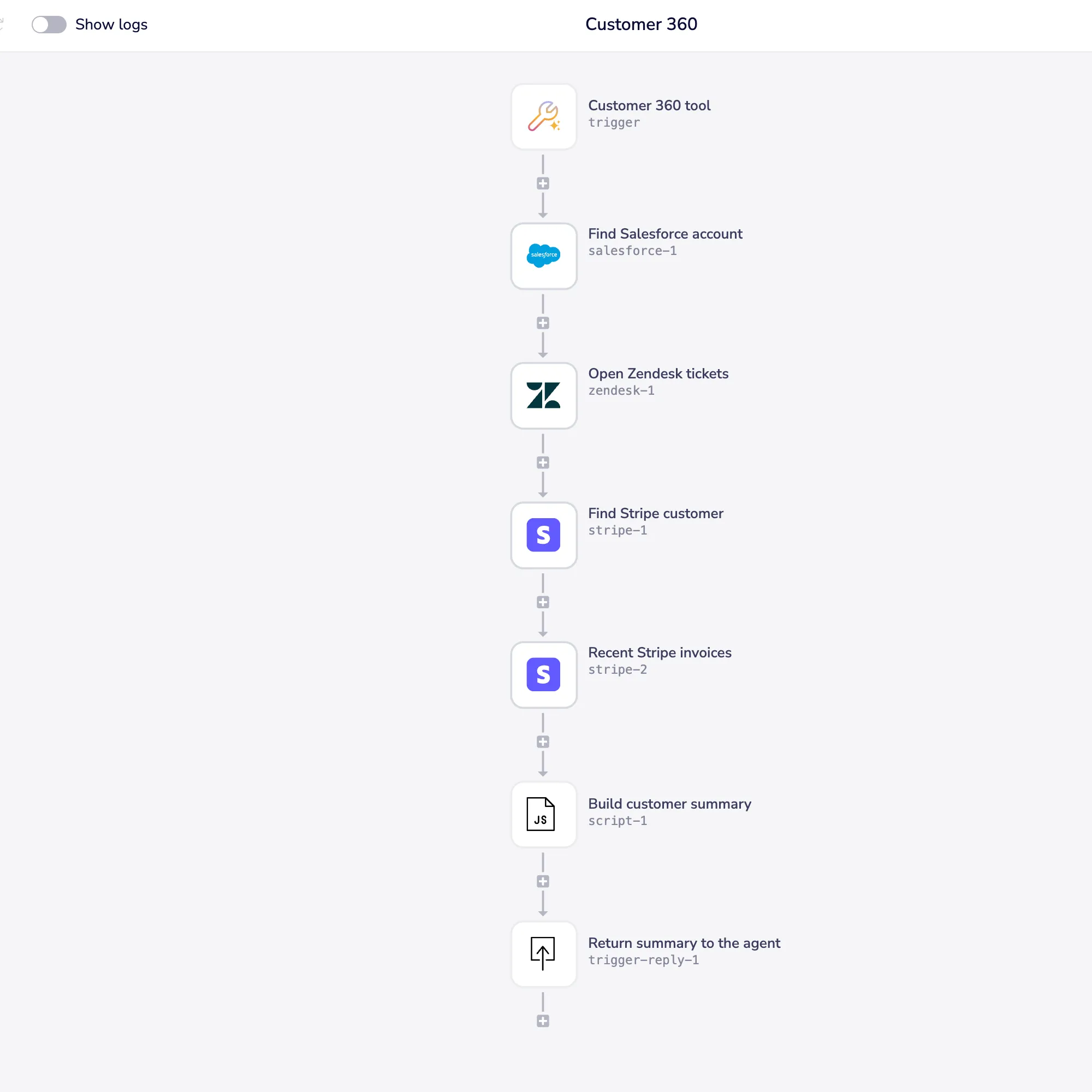
A workflow an agent calls as a tool

- MCP tools reduced to about 20 governed workflows
- 500+ → ~20
- raw database access, with governed MCP launched in weeks
- 0
“We can now use Tray.ai to spin up new MCP Tools on a managed path. IT approves what's built, enforces policies and permissions, versions it, and publishes. We get centralized visibility and auditability across the MCP Servers and Tools we deploy, reducing risk.”
How you build the API behind the endpoint
The logic behind each API is a workflow. Build it on the Tray Build canvas, or describe it to Claude Code or Codex and let Tray Headless build it. Agent Gateway for MCP governs the tool calls agents make.
- Tray Build: a visual canvas for the workflow behind the API
- Claude Code and Codex with Tray Headless: describe the API in plain language
- Agent Gateway for MCP governs agent tool calls
- The Development page covers both ways to build.
What you can build
See what teams build with API Management.
-
Query Salesforce without touching Salesforce
Publish a governed read API over Salesforce and Snowflake, so engineering gets the data and the source systems stay protected.
-
A versioned API for partners
Give customers and partners an API with their own credentials, rate limits and documentation, with no custom build for each.
-
One webhook endpoint for every vendor
Accept inbound webhooks, normalize each payload and route it to the right internal system.
-
A governed MCP tool for an agent
Serve a workflow that looks up an order in NetSuite to an AI agent as an MCP tool, with no raw database access.
Frequently asked questions
What is an API management platform?
It publishes, secures, versions and monitors APIs. Tray adds that on top of workflows, so any workflow can become a governed API with authentication, rate limits and usage tracking.
Is this a full API gateway or just API publishing?
It covers authentication, rate limiting, versioning, monitoring and a developer portal, so it is more than a webhook receiver or trigger endpoint.
Can I expose APIs to partners or customers?
Yes. Issue per-consumer credentials, set individual rate limits and give external consumers a self-serve portal.
How does API management work with MCP?
Tray iPaaS serves workflows, and the apps they connect to, to AI agents as governed MCP tools, with the same authentication and rate limits as any API. Agent Gateway for MCP governs the tool calls agents make.
How does it connect to the rest of the platform?
The logic behind each API is a workflow, so it can call any of the 12,000+ apps, databases, APIs and services Tray connects to, run transformations and trigger downstream automations.
Can Tray generate an MCP server from an OpenAPI or Swagger spec?
Yes. Give Tray an OpenAPI (Swagger) spec and the CDK builds a connector from it. Agent Gateway then exposes it as a governed MCP tool.
How do I build an API on Tray?
Build the workflow on the Tray Build canvas, or describe it to Claude Code or Codex and let Tray Headless build it, then publish it as an API.
How is API management priced?
Pricing is usage-based, and one usage balance covers integrations, AI-built apps and document AI. Talk to us to see how API traffic fits your usage.
Build it
Step by step guides with copy-paste prompts for your coding assistant, and what it takes to run each one in production.






Solutions that run on API Management.
Partner integrations
How partner integrations run a partner program from signed agreement to partner paid: where it breaks, the systems it runs on, and a guide for each stage.
MCP for Salesforce and HubSpot
Give AI agents governed access to your CRM without raw database exposure. Tray.ai turns Salesforce and HubSpot into managed MCP tools with RBAC and audit.
One platform
Six capabilities, built as one iPaaS.
Process automation, data integration, API management and MCP, connectivity, embedded integration and document processing , all in Tray iPaaS, sharing the same connectivity, governance layer and data model. Not acquired and stitched. Built as one.
See API Management in action.
Walk through a scenario from your stack with a Tray.ai expert.
Thanks. Someone from our team will be in touch soon.