










.DkNUKaKx_ZLAT4m.webp?dpl=dpl_DawNsPcPVE3m8wfNUAWWNqyYNSaq)








A lead with no company name cannot be matched to an account. A lead with no employee count cannot be scored. A lead that cannot be scored cannot be routed, so it sits in a queue with a few hundred others waiting for someone to notice. Enrichment is the step where a lead either becomes routable or quietly stops moving.
That makes it the least visible failure in the lifecycle. A routing rule that breaks sends leads to the wrong rep, and the wrong rep complains. Enrichment that breaks sends nothing anywhere.
What is lead enrichment?
Lead enrichment is the process of filling in the fields a lead arrives without, so the rest of your lifecycle has something to act on. A form capture might give you an email address and a first name. Routing needs a territory, scoring needs a company size, and matching needs a domain that resolves to an account already in the CRM.
Most teams do this with a data vendor — Clearbit, Datafox, DiscoverOrg, D&B Optimizer and others match a lead against their own database on email domain or company name and return whatever they hold.
Why enrichment vendors leave a remainder
Enrichment inherits whatever the upload step wrote, so a lead that arrived without a usable company field was already unresolvable before the vendor saw it.
Vendors resolve most of a list. They do not resolve all of it, and the remainder is where enrichment becomes an operational problem rather than a purchase.
Personal email addresses do not carry a company domain. Small companies and new ones are thin in every database. Non-US records are patchier than US ones. So a list comes back partly filled, and the unmatched records need a second path: a research contractor, an internal researcher, or a rule that holds the lead back rather than routing it on data nobody has.
Teams that skip the second path end up routing on blanks. Cisco cut invalid leads by 60% and improved lead response time by 80% by handling this properly upstream rather than letting sales sort it out.
The cost of not handling it shows up later and somewhere else. A 2021 study of 5.7 million inbound leads across more than 400 companies found that only 23% of leads ever got touched by a sales rep, and 57.1% of first attempts happened more than a week after the lead arrived.1 Nobody has published a rigorous measurement since, so treat that as a shape rather than a current number. The shape has not changed: leads that need a human decision before they can move are the ones that do not move.
Why a working enrichment script still stops being usable
Wiring an enrichment call into your intake is an afternoon’s work now. The vendor has an API, your coding assistant knows the shape of a POST request, and the first version works on the first list you test it against.
The second path is what it does not have. When a record comes back unmatched, a working script does one of three things: writes a blank, throws an error into a log nobody reads, or stops. None of those is a decision, and enrichment is a step that needs a decision on every record.
So the team adds one. A holding status, a form for the contractor, a rule about what counts as enriched enough to route. Each addition is reasonable and each one makes the thing harder to hand to anyone else. One MOps director at a software company with more than 1,000 employees described the result as a lot of automations in the wild — things that run, that work, and that only one person can explain.
Gartner forecasts that 60% of vibe-coded applications will be retired by 2028 for failing to deliver predictable business value.2 The answer to that is not to stop building them. It is to build them somewhere they can be run and maintained by more than the person who wrote them.
What to do with the records a vendor cannot resolve
Here is how we handle the unmatched remainder at Tray.ai.
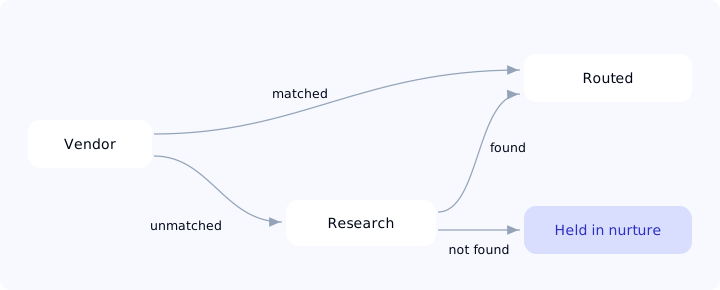
A research contractor receives the records the vendor could not resolve and fills in a form with whatever they find. Submitting the form triggers a workflow that looks up the matching lead in Salesforce by email address, checks whether the researcher marked the lookup successful, and then updates only the fields that were empty — company name first, then the rest.
The part worth copying is what happens when the researcher finds nothing. The lead is marked as bad data and held back rather than routed. It goes into nurture instead, where a later form fill might supply what the vendor could not. A rep never receives it, so a rep never wastes a call on it and never learns to distrust the queue.
That hold-back rule is the whole difference between enrichment as a data step and enrichment as a lifecycle step. Routing on a blank is worse than not routing at all, because it spends a rep’s attention and teaches them the leads are junk.
What breaks downstream when enrichment is wrong
Enrichment sits in the middle of a chain, and everything downstream inherits whatever it produces.
Lead-to-account matching needs a resolvable company domain. Scoring needs firmographics that are actually populated rather than defaulted. Routing needs a territory, which usually derives from a field enrichment supplies. Reporting needs all of it to be consistent, or the funnel numbers describe your data quality rather than your demand.
Run enrichment badly and each of those steps produces a plausible-looking output from bad input. That is harder to catch than an outright failure, and it is why enrichment is worth getting right before anything after it.
The rest of this lifecycle is covered across the revenue operations automations library, and how the six lifecycle steps depend on each other walks the full chain.
Which of your automations breaks first? Take the assessment — it ranks what your team already runs by who can change it, how you would find out it stopped, how many systems it touches, and what a break costs.
Sources
- XANT, Lead Response Report, 17 February 2021. Based on 55 million interactions and 5.7 million inbound leads across more than 400 companies.
- Gartner, Govern Vibe Coding for Citizen Developers With Self-Service Platforms, Tyagi, 29 June 2026, G00858202. GARTNER is a registered trademark and service mark of Gartner, Inc. and/or its affiliates in the U.S. and internationally and is used herein with permission. All rights reserved.