









.DkNUKaKx_ZLAT4m.webp?dpl=dpl_FFQ9uu6rhRCm54BGxZwaW513PntG)









A lead arrives, and six things have to happen before a rep can do anything with it. It has to land in the system of record, arrive complete enough to act on, resolve to an account, get a score, get an owner, and end up counted correctly.
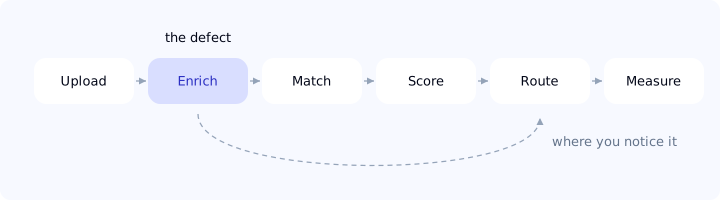
Each step depends on the one before it. That is what makes lifecycle problems hard to diagnose: the failure almost never shows up where it started. Reps complain that the leads are junk, and the cause is a matching rule three steps upstream. The funnel report shows a conversion drop, and the cause is a vendor field that changed name.
What is lead lifecycle management?
Lead lifecycle management is the set of processes that move a lead from first contact to a sales-ready record with an owner. It spans capture, validation, enrichment, account matching, scoring, routing, and the reporting that tells you whether any of it worked.
The lifecycle is not standardized across companies. What is consistent is the sequence of dependencies: every step consumes what the previous step produced, so a defect introduced early travels the whole way down and gets harder to see at each stage.
The stages a lead moves through
Most teams label leads against something close to this ladder:
- Anonymous: activity you can see but cannot yet attach to a person
- Known: an identified person who has not engaged meaningfully
- Lead: engaged enough to warrant follow-up, usually into nurture
- Marketing qualified (MQL): engaged enough to be worth a sales look
- Sales qualified (SQL): a development rep has qualified it
- Sales qualified opportunity (SQO): an account executive agrees it is worth working
The labels are the easy part. Moving a record between them reliably is where the work is, because each transition depends on a field that something upstream had to populate correctly.
The six steps, and what breaks at each one
Capture and upload. Leads arrive from forms, events, list purchases and partner files, and they have to reach the system of record in a consistent shape. Uploads break on formatting more than anything else: a column order that changed, a date format, a file that arrived with 12,000 rows instead of 1,200. Why lead list uploads fail before the leads are routable, and how to build import and validation.
Enrichment. A lead with no company name cannot be matched, and a lead with no employee count cannot be scored. Vendors resolve most of a list and leave a remainder, and the remainder needs a decision rather than a blank. Where enrichment stalls, and how to build it.
Lead-to-account matching. New leads have to resolve against accounts already in the CRM, or the same company arrives three times under three spellings and three reps call it. When the same person arrives twice, lead deduplication merges the records. Why leads and accounts drift apart, and how to build matching and dedupe and merge.
Scoring. A score decides what gets attention first. Scores drift because the model was fitted to a market that moved, or because a field it depends on stopped being populated. Lead scoring goes into why scores drift and what to fix first.
Routing. Routing assigns an owner. Rules outlive the org chart they were written for, so leads land with reps who left, territories that were redrawn, and queues nobody watches. Why routing rules go stale, and how to build routing.
Measurement. Reporting tells you which of the above is working. When the underlying records are inconsistent, the funnel numbers describe your data quality rather than your demand. CRM data hygiene covers the record problems that make funnel numbers misleading.
If you want the sequence as a single process rather than six, lead processing pipelines covers it end to end.
The lead routing pillar splits the same path into nine stages, with a post on each:
- Capture and validate: Lead list uploads: why leads arrive unroutable
- Events and webinars: Webinar lead follow-up: why event leads go cold
- Enrichment: Lead enrichment automation: where it stalls and why
- Dedupe and merge: Lead deduplication: why duplicates come back
- Lead-to-account matching: Lead-to-account matching: why leads and accounts drift apart
- Scoring and qualification: Lead scoring: why the score stops matching reality
- Routing and assignment: Lead routing automation: why rules outlive the org chart
- Rep alert and escalation: Speed to lead: where the minutes go
- First touch and sequence: Lead follow-up: when sequences ignore the CRM
Why speed is what exposes the breakage
Every defect above costs time, and time is the one lifecycle cost that has been measured properly.
A study of 5.7 million inbound leads across more than 400 companies, published in 2021, found that only 23% of leads ever got touched by a sales rep, and 57.1% of first attempts happened more than a week after the lead arrived.1 Conversion was substantially higher when the first attempt came inside five minutes. No rigorous public measurement has replaced that study, so treat the specific figures as a shape rather than a current benchmark.
What the shape describes is a queue. Leads that need a human decision before they can move are the leads that do not move, and every broken step above creates exactly that kind of lead.
The gap between a lifecycle that works and one that does not is wide. Kevin Cassidy, Director of Marketing Operations at DocuSign, described the change after the company rebuilt how leads reached sales: they went from 90% of leads reaching the sales team in under ten minutes to 99% of our leads to the sales team in under 3 minutes.
Cisco cut invalid leads by 60% and improved lead response time by 80%.
Why broken steps stay broken
Everyone involved can name the problem. Marketing operations professionals rank ability to integrate
as their single most important martech buying criterion, at 81.3%, ahead of price, features and support.5
What’s missing is capacity, in the team that would normally do the work. IT teams spend an average of 36% of their time designing, building and testing new custom integrations, according to MuleSoft’s 2026 connectivity research.6 That is more than a third of an engineering function’s year spent on connective work that never finishes, which is why a request to fix lead routing joins a queue rather than a sprint.
Scale makes it worse rather than better. Cisco runs more than 60 separate automations across its go-to-market operation. A lead lifecycle is dozens of small integrations to maintain, each with its own upstream dependency and its own way of failing without anyone noticing.
Why your team now builds these steps, and where that stops
Each step in the chain used to be a tool you bought. That stopped being available at the rate the work requires. A single-purpose GTM app carries a median contract value of $16,269, and one pure Salesforce routing app lists at $45 per user per month with a five-user minimum, which is $27,000 a year to route 50 reps.2, 3 Meanwhile 79% of IT leaders saw a SaaS price increase within twelve months, and 61% have cut projects to absorb unplanned cost rises.4
So the work moved in-house, and building it stopped being the constraint. A routing rule, an enrichment fallback, a dedupe check: each is an afternoon with a coding assistant, and the first version works.
What follows is the part nobody plans for, and Gartner is direct about how durable it is: the distance between a working prototype and something running in production is the defining constraint in this market
, to be treated as a planning constant, not a temporary limitation.
7
One MOps director at a software company with more than 1,000 employees described what their team ended up with as a lot of automations in the wild: things that run, that work, and that only one person can explain. Gartner forecasts that 60% of vibe-coded applications will be retired by 2028 for failing to deliver predictable business value.8
Teams will keep building. Gartner also expects 75% of RevOps tasks in workflow management, data stewardship, revenue analytics and revtech administration to be executed by agentic AI by 2028, which means considerably more of this gets built, not less.9 What has to change is where it gets built, so that the thing surviving in your lifecycle is not one person’s script.
Which of your automations breaks first? Take the assessment. It ranks what your team already runs by who can change it, how you would find out it stopped, how many systems it touches, and what a break costs.
For a comparison of the tools that automate this process, see the best lead routing software.
Sources
- XANT, Lead Response Report, 17 February 2021. Based on 55 million interactions and 5.7 million inbound leads across more than 400 companies.
- Vendr per-product pricing data, computed from 6,309 purchases, 2026. Median contract value for a genuinely single-purpose GTM app.
- G2 pricing, Distribution Engine, 2026.
- Zylo, 2026 SaaS Management Index, 29 January 2026. Based on 40 million licenses and $75 billion under management.
- MarketingOps.com survey of 600+ marketing operations professionals, via chiefmartec, November 2024.
- MuleSoft, 2026 Connectivity Benchmark, 5 February 2026. Based on 1,050 IT leaders.
- Gartner, Market Guide for Enterprise Vibe Coding Platforms, Swan, Bhat, Blosen, 28 April 2026, G00844703.
- Gartner, Govern Vibe Coding for Citizen Developers With Self-Service Platforms, Tyagi, 29 June 2026, G00858202.
- Gartner, AI Agents Will Redefine How RevOps Drives Go-to-Market Success, Rietberg, O’Sullivan, Lopez, 9 July 2025, G00826255.
GARTNER is a registered trademark and service mark of Gartner, Inc. and/or its affiliates in the U.S. and internationally and is used herein with permission. All rights reserved.


