Skip to content

Solutions / Use case

Order-to-cash automation, from quote to cash applied.

Every stage runs across CRM, CPQ, ERP, billing and payments. When those systems don't talk, orders wait and invoices go out late. Connect every handoff on Tray.ai, and your finance team only looks at the orders that need a person.

Great — a couple more details

This helps us connect you with the right person. Optional, and you can skip it.

Jump to the stages
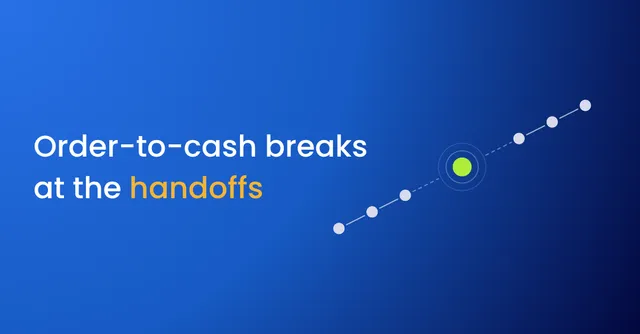
One deal moving through order-to-cash: closed won in Salesforce, signed in DocuSign, booked as a sales order in NetSuite, invoiced from Zuora, paid through Stripe, cash applied in NetSuite, and the paid status written back to Salesforce.

The short answer

What is order-to-cash?

Order-to-cash (O2C) is the process that turns a closed deal into recognized revenue: quoting, contracting, booking the order, provisioning, invoicing, collecting, applying cash and closing the books. At a software company it runs across CRM, CPQ, ERP, billing and payment systems, and most delays happen in the handoff between two of them.

  1. 1 Quote and CPQ
  2. 2 Contract and sign
  3. 3 Book the order
  4. 4 Provision
  5. 5 Invoice
  6. 6 Collect
  7. 7 Apply cash
  8. 8 Recognize and close
manual effort per sales order at Mixpanel
−25%
connectors, from Salesforce and NetSuite to Stripe and Zuora
700+
processes run on Tray.ai a year
1T+

The order-to-cash process, stage by stage

Eight stages, each with what breaks and a how-to guide for building it.

  1. 1

    Quote and configure

    The quote sets products, price steps, discounts and terms. Every later system inherits it.

    Where it breaks: A CPQ product with no matching ERP item, found only when the order fails to book.

  2. 2

    Contract, approval and signature

    Non-standard terms get approved, then signed. Finance bills against the signed contract.

    Where it breaks: The signed version differs from the quote, and the order books from the quote.

  3. 3

    Order booking

    Closed-won creates the customer and sales order in the ERP, from the signed contract.

    Where it breaks: A retry creates a second order for one deal. Finance finds it at month end.

  4. 4

    Provisioning and onboarding

    The customer gets access on the start date, to what they bought, and onboarding gets what was promised.

    Where it breaks: Access weeks late, or access that no longer matches the contract.

  5. 5

    Billing and invoicing

    Invoices go out on the contract schedule, price steps and usage included, and show in the CRM.

    Where it breaks: The account manager has to ask finance whether the invoice went out.

  6. 6

    Collections and receivables

    Reminders and escalation per customer, stopped the moment they pay or dispute.

    Where it breaks: Chasing payment from an account that's mid-renewal.

  7. 7

    Cash application and reconciliation

    Payments are matched to invoices. Anything unmatched stays visible until someone resolves it.

    Where it breaks: The customer paid, the invoice still shows open, and collections keeps chasing.

  8. 8

    Revenue recognition and close

    Revenue is recognized as the contract is delivered, and bookings reconcile to revenue every period.

    Where it breaks: Schedules built from invoice totals, which the auditor can't trace.

Three ways to connect the systems

  • App-to-app connectors are quick for one pair, but each covers a single handoff and none of them check against the others.
  • Custom code gives full control, and your team owns the fixes, changes and monitoring for as long as it runs.
  • An integration platform puts every handoff in one place, with the same error handling and logging throughout. This is Tray.ai: finance and RevOps build the workflows, IT governs them.

The Tray.ai platform behind it

Tray.ai is the enterprise orchestration platform for data and AI. These are the parts of it that run order-to-cash.

The metrics order-to-cash moves

What finance and RevOps teams measure, and which stage each number depends on.

Days sales outstanding (DSO)
Average number of days between raising an invoice and receiving the cash.
What moves it Invoices that go out on schedule, and collections that start on the due date. How to build collections and dunning 
Order-to-invoice time
Days from closed-won to the first invoice.
What moves it Booking the order from the CRM the moment the deal closes. How to build an order-to-cash integration 
Order error rate
Share of orders corrected after they were booked.
What moves it Validating the deal in the CRM before anything is written to the ERP. How to build a CPQ to ERP sync 
Unapplied cash
Payments received that are not yet matched to an invoice.
What moves it Matching payments to invoices automatically, with anything unclear sent to a person. How to build bank reconciliation automation 
Billing leakage
Contracted value that never reaches an invoice.
What moves it Reconciling contract to subscription to invoice on a schedule. How to build a revenue recognition feed 
Days to close
Business days from period end to closed books.
What moves it Reconciliations that run all month instead of in the last week. How to build financial close automation 

Order-to-cash connectors

The systems order-to-cash runs on, grouped by the seat each one fills. Each links to its connector page.

CRM

Where the deal closes, and where the account team needs to see invoice and payment status.

CPQ and contracts

Where the quote is configured, approved and signed.

ERP and accounting

Where the order, the invoice and the revenue live.

Billing and payments

Where subscriptions are billed and payments are taken.

Provisioning, support and collaboration

Where access is granted, disputes arrive and exceptions get worked.

Data and reporting

Where bookings, billings and revenue are reconciled and reported.

Anything not listed connects through the full connector library, or directly through its API.

−25% manual effort per sales order at Mixpanel

“Automation has fundamentally changed our approach to building processes. So far, we have yet to find something that Tray can't do.”

Kara Barcelon
Controller, Mixpanel

Frequently asked questions

What is the difference between order-to-cash and quote-to-cash?

+

Quote-to-cash starts earlier, at quoting and product configuration, and sales operations usually owns that part. Order-to-cash is often used for the whole span as well. At a software company the two overlap almost entirely, which is why this page starts at the quote.

How is order-to-cash different from procure-to-pay?

+

Procure-to-pay is the buy side, from purchase request to supplier payment. Order-to-cash is the sell side, from quote to cash received. The two share the ERP and the general ledger.

Which systems does Tray.ai connect in order-to-cash?

+

CRM (Salesforce, HubSpot, Microsoft Dynamics 365), CPQ and contracts (Salesforce CPQ, DealHub, DocuSign, Ironclad, PandaDoc), ERP and accounting (NetSuite, SAP Business One, Sage Intacct, Workday, QuickBooks, Xero), billing and payments (Zuora, Chargebee, Recurly, Stripe, PayPal, Braintree), and the warehouse for reporting (Snowflake, Google BigQuery). Anything without a connector connects through its API.

Can finance or RevOps build this without engineering?

+

Yes. At Mixpanel, engineers and the non-technical revenue team both build on Tray, and automating order-to-cash cut manual effort per sales order by 25%.

Should order-to-cash sync run in real time or in batches?

+

Both. Bookings and status updates should happen the moment something changes, so an order exists minutes after the deal closes. A scheduled reconciliation then compares the systems, because a missed event sends no error and nothing else will notice it.

Where do AI agents fit in order-to-cash?

+

In the exceptions. Agents match payments with messy references, triage billing disputes from support tickets, draft collections emails for review and flag contract terms that do not match the order. Anything that changes an amount goes to a person for approval.

Do we have to replace our ERP or billing system?

+

No. Tray.ai connects the systems you already run and carries the data between them. The stages above describe what moves between systems, not which ones you use.

Last reviewed 1 October 2026.

See order-to-cash running on your stack.

Walk through your systems and stages with a Tray.ai expert.

Great — a couple more details

This helps us connect you with the right person. Optional, and you can skip it.

Browse the how-to guides